Treadmill Running for Beginners: Start Running Indoors With Confidence
Quick Answer: To start running on a treadmill as a beginner, use walk-run intervals: walk 3 minutes at 3.0–3.5 mph, then jog 1 minute at 4.5–5.0 mph, repeated 6–8 times. Set the incline to 1% to mimic outdoor running. Do this 3 times a week and add 30 seconds to each running interval weekly. Most people can jog 20 continuous minutes within 8 weeks.
The treadmill gets called the “dreadmill” by people who already know how to run. For someone starting from zero, it’s the single most forgiving place to learn.
Nobody’s watching. The weather is irrelevant. The pace is a number you choose rather than a guess. And if it goes badly, you press stop and you’re already home.
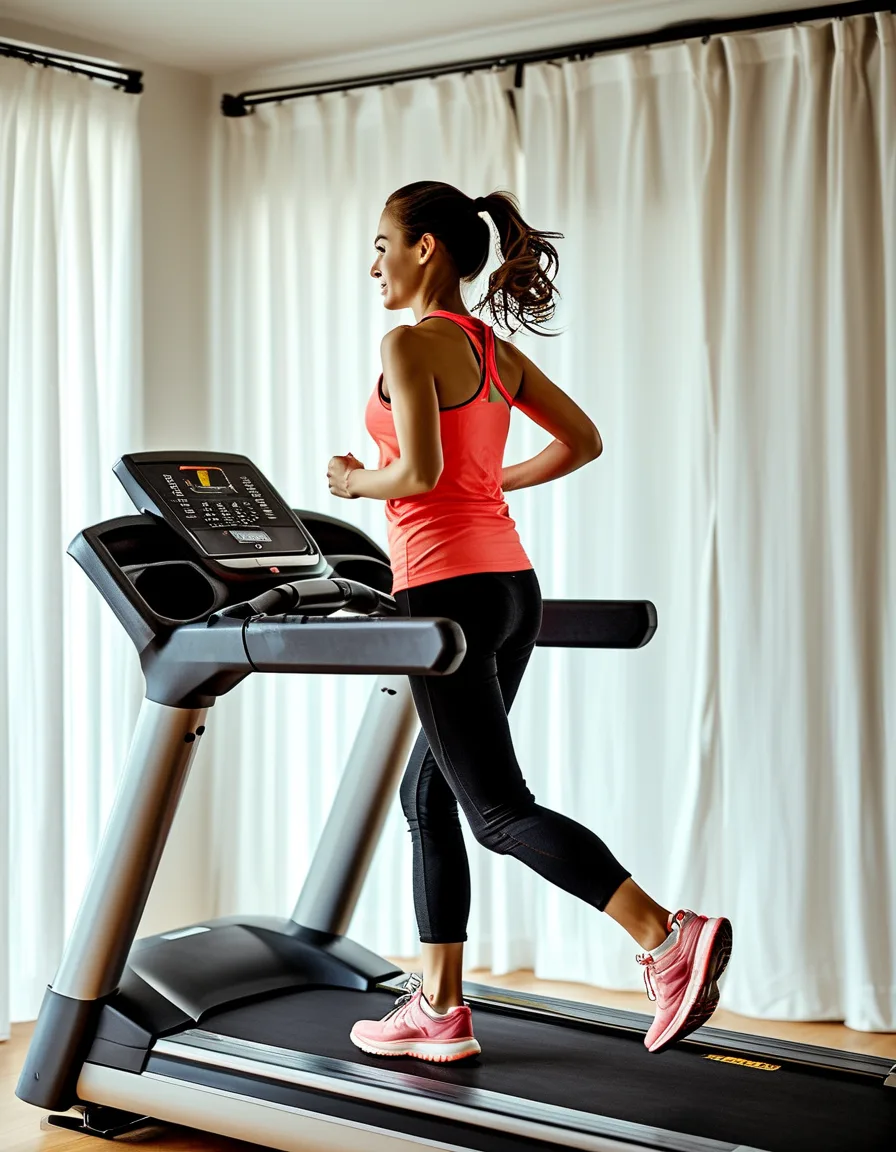
Why Is the Treadmill Good for Beginner Runners?
You control the pace precisely. The most common beginner mistake outdoors is starting too fast — enthusiasm sets a pace your fitness can’t hold, and you’re walking, defeated, four minutes later. A treadmill removes the guesswork. You set 4.5 mph and you run 4.5 mph.
The surface is forgiving. A cushioned belt absorbs meaningfully more impact than concrete, which matters a lot in the first weeks when your tendons and joints are adapting to a new stress.
No weather, no daylight, no route planning. The three most common excuses stop applying.
It’s private. For a lot of new runners, the self-consciousness barrier is real and larger than the fitness barrier. A treadmill in a corner of a gym — or at home — removes it.
Intervals are effortless to execute. Press a button, the pace changes. Doing precise walk-run intervals outdoors requires a watch and discipline; here it requires a thumb.

How to Start Running on a Treadmill (Week by Week)
The method is walk-run intervals, and it works because it lets your cardiovascular system and your connective tissue adapt at their own different speeds.
Warm up 5 minutes at 3.0–3.5 mph before every session. Cool down 5 minutes the same way.
| Week | Interval | Repeats | Total run time |
|---|---|---|---|
| 1–2 | Walk 3 min / Jog 1 min | 6 | 6 min |
| 3–4 | Walk 2.5 min / Jog 1.5 min | 6 | 9 min |
| 5–6 | Walk 2 min / Jog 3 min | 5 | 15 min |
| 7–8 | Walk 1 min / Jog 5 min | 4 | 20 min |
Three sessions a week, with a rest day between each. Jog pace for most beginners lands at 4.5–5.0 mph — it should feel like you could speak a short sentence but wouldn’t enjoy holding a conversation.
If a week feels too hard, repeat it. Nobody is grading this, and the runners who get injured are almost always the ones who refused to repeat a week.
Set the Incline to 1%
This is the single most useful treadmill setting nobody tells beginners about.
At 0% incline, the belt is moving under you, which removes a small amount of the work that wind resistance and forward propulsion demand outdoors. Setting 1% closes that gap and makes your treadmill pace roughly equivalent to the same pace outside — which matters the day you decide to run outdoors and don’t want an unpleasant surprise.
Don’t go higher than 1–2% while you’re learning. Steep incline walking is a legitimate workout, but it’s a different one.
Myth vs Fact: Treadmill Running
Myth: Holding the handrails is fine, it’s just for balance. Fact: Gripping the rails transfers your weight into your arms, shortens your stride, and can strain your shoulders and lower back. If you need the rails to sustain the pace, the pace is too fast. Let go — arms bent at about 90 degrees, swinging freely.
Myth: Treadmill running is easier, so it doesn’t count. Fact: At 1% incline the physiological demand is very close to outdoor running at the same pace. What’s genuinely easier is the mental side — no hills you didn’t choose, no headwind.
Myth: You should look down at the belt. Fact: Looking down tips your head forward and rounds your upper back, which restricts breathing. Eyes forward, chest tall, shoulders relaxed and away from your ears.
Myth: More sessions means faster progress. Fact: Adaptation happens on rest days. Three runs a week with rest between them beats five runs a week that end in shin splints in week four.
How Do You Not Get Bored?
This is the treadmill’s genuine weakness, and it’s solvable. Beating treadmill boredom comes down to giving your brain something to track:
- Vary the session. Intervals one day, steady effort another, a gentle incline walk on the third. Identical workouts are what kill treadmill habits.
- Cover the display. A hand towel over the numbers turns a countdown into a run. Weirdly effective.
- Match the media to the session. Podcasts and audiobooks for steady runs, high-BPM music for intervals. A show works if the treadmill faces a screen.
- Track something. A simple log of total running minutes per week gives you a number that goes up, which is more motivating than it sounds.
- Celebrate the actual milestone. Going from walking to jogging 20 straight minutes in 8 weeks is a genuine fitness transformation. Mark it.
Once you can run 20 continuous minutes indoors, take one session a week outside. The treadmill built the engine; outdoors is where you find out what it does.
FAQ
What speed should a beginner run on a treadmill?
Walk at 3.0–3.5 mph and jog at 4.5–5.0 mph to start. The right jog pace is one where you could say a short sentence but couldn’t comfortably hold a conversation — adjust the number until that’s true for you, since fitness varies more than the dial does.
How long should a beginner run on a treadmill?
Total session length of 30–35 minutes including a 5-minute warm-up and cool-down, with only 6–20 of those minutes actually running depending on your week. Time on your feet matters more than continuous running in the first two months.
Is it OK to run on a treadmill every day?
Not when you’re starting out. Your heart adapts within days but tendons, ligaments, and bones take weeks, and daily running is the fastest route to shin splints. Three days a week with rest days between is the right dose for the first 8 weeks.
TL;DR:
- Walk-run intervals are the method: walk 3 min / jog 1 min, 6 rounds, 3x weekly.
- Set incline to 1% so indoor pace matches outdoor effort.
- Jog at 4.5–5.0 mph — talk-a-short-sentence pace.
- Never hold the handrails; if you need them, slow the belt down.
- Add 30 seconds to each running interval per week; expect 20 continuous minutes by week 8.
Keep Reading
This article is for general informational and styling purposes only. Fit, sizing, and product availability may vary.