The First Ten Minutes on a Treadmill: Questions Answered
Quick Answer: The first ten minutes of any run are physiologically the hardest, because oxygen delivery lags demand, heart rate is still climbing, and muscle temperature is low. On a treadmill this is amplified by a fixed pace that doesn’t let you self-adjust and by the absence of the visual and environmental feedback that normally distracts you. Judge a run at minute twelve, not minute three.
Here are the questions runners actually ask about that window.

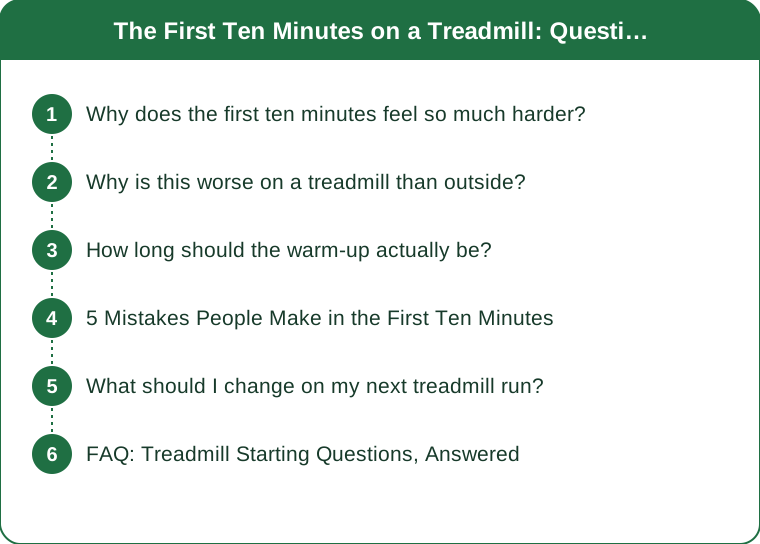
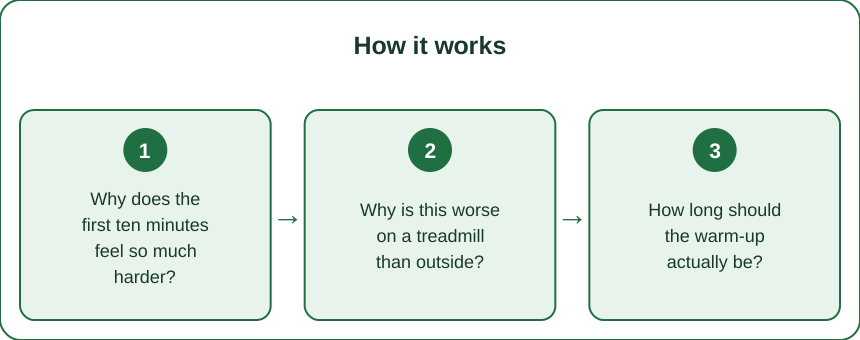
Why does the first ten minutes feel so much harder?
Because your aerobic system takes several minutes to catch up with demand, and until it does you’re running partly on anaerobic contribution.
The technical name is the oxygen deficit. At the start of exercise, oxygen delivery to muscle rises more slowly than the demand for it. The shortfall is covered anaerobically, which produces the heavy-legged, laboured feeling of the first few minutes. Once oxygen delivery catches up, typically within 2 to 4 minutes at steady effort but with the full settling taking closer to 10, the same pace feels substantially easier.
At the same time:
Muscle temperature is low. Muscle works better warm. Enzyme activity, contraction speed, and tissue compliance all improve as temperature rises, and it takes 8 to 10 minutes of activity to get there.
Heart rate is still climbing toward steady state, and stroke volume hasn’t stabilised.
Blood flow is still redistributing from digestive and other tissue toward working muscle.
So is that feeling telling me anything useful?
Rarely. It’s telling you that you started running, which you already knew. The information about whether the session is going well arrives around minute twelve.
Why is this worse on a treadmill than outside?
Three reasons, and only one of them is physiological.
The pace is fixed. Outdoors you unconsciously start slower and accelerate as you warm up. Almost everyone does this, and it’s an effective self-managed warm-up. On a treadmill you set a number and the belt holds it, so you’re running your target pace during the exact window when your body is least ready for it.
There’s no distraction. Outdoors, the first ten minutes contain traffic, junctions, other people, and changing scenery. All of that occupies attention that would otherwise be spent monitoring how hard this feels. On a treadmill you have a display counting slowly upward.
Heat builds faster. No airflow means heat accumulates from the start, so the perceived exertion curve is steeper indoors. This becomes a much bigger factor once heating is on in autumn and winter.
Does that mean treadmill running is harder?
Not at steady state, and it is harder in that first window. Once you’re past ten minutes and thermally settled, the difference between treadmill and outdoor effort at the same pace is small, with the main factor being the absence of air resistance, which is why the 1 percent incline convention exists.
How long should the warm-up actually be?
Long enough to cover the settling period, which means the warm-up is the first ten minutes rather than a preamble to them.
A workable structure: 3 minutes walking at a brisk pace, 3 minutes very easy jogging, then 4 minutes building gradually toward your target pace. At minute ten you begin the session proper, and it starts feeling like a run rather than a negotiation.
In autumn and winter, extend it. Starting from a cold room or straight from a cold commute means muscle temperature is lower to begin with. Adding 3 to 5 minutes is reasonable, and a cold garage treadmill needs more still.
For intervals, warm up longer, not shorter. A hard first interval on a cold system is where most treadmill sessions go badly, and 12 to 15 minutes before the first hard rep is not excessive.
For an easy run, the warm-up can be the run. Start at a walk, build over ten minutes, and let the whole first third be a progression.
Should I stretch before?
Static stretching on cold muscle before running has no established performance benefit and may transiently reduce power output. Movement-based warm-up does the job better. Save static stretching for afterwards, if you like it.

5 Mistakes People Make in the First Ten Minutes
1. Setting target pace from minute one. The single most common treadmill error. It makes the hardest window harder and it colours the whole session.
2. Judging the session too early. Deciding at minute four that today is a bad day, then cutting the run short. Minute four is uninformative for everybody.
3. Turning the fan on late. Heat accumulation begins immediately. Starting the fan at minute fifteen means you’ve already banked heat that has to be shed.
4. Checking the display constantly. The clock moves slowest when watched, and perceived exertion rises with attention paid to it. Covering the display for the first ten minutes is a genuinely effective trick.
5. Skipping the walk. Three minutes of brisk walking raises heart rate and muscle temperature at almost no cost, and it’s the part people cut when short of time. The second one costs the most sessions, because a run abandoned at minute five would very often have been fine at minute fifteen.
What should I change on my next treadmill run?
Build the first ten minutes into the plan rather than treating them as time before the run. Write the session as 10 minutes progressive, then the work.
Start the fan before you start the belt. Airflow from the beginning changes the whole heat curve.
Cover the display for the first ten minutes. A towel over the console. It sounds trivial and it changes perceived exertion measurably for a lot of people.
Set a rule: no decisions before minute twelve. If it’s still genuinely bad at twelve, adjust the session or stop. Before twelve, the information isn’t there.
Check the room. 18 to 20 degrees is a reasonable target for indoor running. Autumn is where this goes wrong, since the heating comes on and the room that was fine in September is too warm by November.
Hydrate before, not during, for shorter runs. 300 to 500ml in the 30 to 60 minutes before is more useful than sipping through the first ten minutes.
What if it still feels wrong at minute fifteen?
Then it’s real information. Common causes are under-fuelling, poor sleep, coming down with something, or accumulated training fatigue. An easy run or a rest day is a reasonable response, and pushing through repeatedly is how people run themselves into a hole. Chest pain, unusual breathlessness, dizziness, or an irregular heartbeat are reasons to stop and seek medical advice rather than to adjust the pace. This is general information, not medical advice.
FAQ: Treadmill Starting Questions, Answered
Why does my heart rate spike early and then drop?
Cardiac drift and the settling of stroke volume, plus an early sympathetic response to starting exercise. A high reading in the first few minutes that settles is normal and not a useful data point.
Is it normal for my legs to feel heavy at the start and fine later?
Yes, and it’s one of the most consistently reported patterns in running. It’s the oxygen deficit combined with cold muscle. If heaviness persists past 20 minutes on multiple runs, that points at fatigue, fuelling, or sleep rather than at warm-up.
Should I use incline during the warm-up?
A 1 to 2 percent incline is fine throughout and it’s better to add incline after the first ten minutes rather than starting with it. Incline raises effort quickly, which is exactly what you don’t want in the window where effort is already disproportionate.
TL;DR:
- The first ten minutes are hardest because oxygen delivery lags demand, muscle temperature is low, and heart rate is still climbing.
- Treadmills make it worse by holding a fixed pace during the window when you’d naturally start slower, with no distraction and no airflow.
- Build a ten-minute progressive start into the session: 3 minutes walking, 3 easy, 4 building.
- Make no decisions about the run before minute twelve, and cover the display until then.
A run abandoned at minute five is usually a run that would have been fine. If it’s still wrong at fifteen, that’s real information about sleep, fuelling, or fatigue. Chest pain, dizziness, or an irregular heartbeat means stop and get medical advice. This is general information, not medical advice.
Keep Reading
This article is for general informational and styling purposes only. Fit, sizing, and product availability may vary.