Is 12-3-30 Still Worth Doing? Questions Answered
Quick Answer: Yes, 12-3-30 is worth doing if you actually do it — 30 minutes at 12 percent incline and 3 mph is a genuine moderate-intensity session that most people can sustain and recover from. It is not special, and it is not optimal for either fat loss or fitness. Its real advantage is adherence: it is boring enough to be repeatable and easy enough to do five times a week.
Every few months it comes back around.
One camp calls it life-changing, the other calls it a scam.
Both are describing the same thirty minutes of walking uphill.

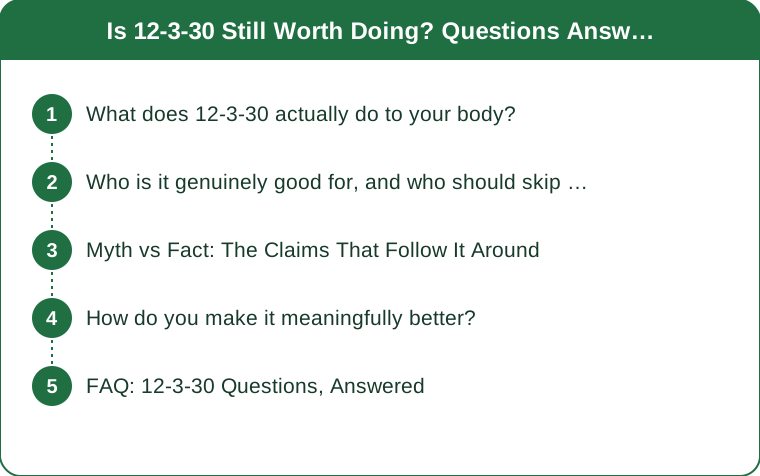
What does 12-3-30 actually do to your body?
It is a moderate-intensity steady-state cardio session, and it should be judged as one.
For most people it lands somewhere between 65 and 80 percent of maximum heart rate. That is squarely in the range that improves aerobic base, and it is high enough to be genuinely taxing for someone new to structured cardio while being low enough to repeat often.
The incline is doing the work, not the speed. 3 mph is a slow walk on flat ground — barely more than strolling. At 12 percent, the same speed roughly doubles the energy cost, because you are lifting your bodyweight vertically with every step.
It loads the posterior chain more than flat walking does. Glutes, hamstrings and calves take a substantially larger share, which is why people report soreness in those places during the first two weeks.
It is easy on the joints relative to running. No flight phase means no impact spike, which is the main reason it works for people who cannot tolerate jogging.
And it burns roughly 200 to 350 calories for most adults, depending heavily on bodyweight. That is a reasonable number for half an hour, and considerably less than the internet claims.
Who is it genuinely good for, and who should skip it?
The fit is narrower than the hype suggests, but real.
It works well if you are returning to exercise
The entry barrier is almost zero. There is no skill, no coordination demand, and the intensity self-limits — you simply cannot go too hard by accident. For someone coming back after a long break, that predictability is worth more than optimality.
It works well if you need low-impact volume
Anyone managing knee sensitivity, returning from a running injury, or carrying more bodyweight often finds incline walking is the only way to accumulate 150 minutes a week without aggravation.
It works badly as your only training
It does nothing for strength, nothing for bone density beyond the legs, and nothing for the upper body. If 12-3-30 is your whole programme, you are missing most of what matters after 35.
It works badly if you already run
For a trained runner, 30 minutes at that intensity is a slightly awkward middle ground — too easy to be a workout, too hard to be pure recovery.
And skip it entirely if you have to hold the rails
Gripping the handles offloads a large share of your bodyweight and quietly deletes most of the benefit. If you cannot let go, the incline is too high for now.

Myth vs Fact: The Claims That Follow It Around
Myth: 12-3-30 burns more calories than running
Fact: it burns less. Thirty minutes of easy jogging costs more energy than thirty minutes of incline walking for almost everyone. The advantage of incline walking is that you can do it more often without breaking down.
Myth: the specific numbers are optimised
Fact: they are arbitrary and that is fine. 12 percent and 3 mph came from one person finding a comfortable setting, not from a lab. 10-3.5-30 or 15-2.5-25 are equally valid.
Myth: it targets fat specifically
Fact: there is no fat-burning zone worth planning around. Lower intensities do use a higher percentage of fat for fuel, but total energy expenditure matters more, and you cannot direct where fat comes off.
Myth: it tones your legs
Fact: it builds some endurance in the calves and glutes and that is about it. Shape change comes from resistance training and body composition, not from walking uphill.
Myth: doing it daily is better
Fact: four to five times a week is the practical ceiling before calf tightness and general fatigue start eating into the rest of your training.
How do you make it meaningfully better?
Three adjustments turn it from adequate into genuinely useful.
Adjustment one: let go of the rails, and lower the incline until you can. This is non-negotiable. If 12 percent means white-knuckling the front bar, start at 6 to 8 percent hands-free and add one percent every week or two. Hands-free at 8 beats gripping at 12 every single time.
Adjustment two: progress something. The programme has no built-in progression, which is why people plateau at week five and get bored at week seven. Add one minute per week, or 0.1 mph, or half a percent of incline — pick one variable and move it. A useful target is 30 minutes at 12 percent and 3.2 mph after three months.
Adjustment three: pair it with two strength sessions a week. Incline walking plus twice-weekly resistance training is a genuinely complete minimum programme for general health. Incline walking alone is not.
And fix the small things. Shoes with some cushioning but not maximal stack height, water on the console, and something to occupy the mind — this is a session that fails on boredom far more often than on difficulty.
If you get calf cramping or persistent shin pain, cut the incline rather than pushing through. This is general information, not medical advice.
FAQ: 12-3-30 Questions, Answered
How long until I see results?
Aerobic changes — lower resting heart rate, easier breathing at the same setting — show up in three to four weeks. Visible body composition change depends almost entirely on eating, and takes months regardless of what cardio you choose.
Can I do it every day?
You can, but most people do better with four or five sessions and a genuine rest day or two. Daily incline walking is a common route to Achilles and calf complaints, particularly in the first month.
Is it safe during pregnancy or with knee problems?
It is often better tolerated than running, but incline changes the load on the knee and lower back in ways that are individual. Talk to a professional who knows your history before starting — this is general information, not medical advice.
What if my treadmill only goes to 10 percent?
Then walk at 10 percent and add speed or time instead. The numbers were never the point.
TL;DR:
- 12-3-30 is a legitimate moderate-intensity cardio session, not a miracle and not a scam.
- The incline does the work — 3 mph flat is nothing, 3 mph at 12 percent roughly doubles the cost.
- Holding the rails deletes most of the benefit; lower the incline until you can go hands-free.
- It has no built-in progression, so add a minute, a tenth of a mph, or half a percent each week.
- It is incomplete on its own — pair it with two strength sessions a week.
The reason it keeps resurfacing is not that it is optimal. It is that it is repeatable, and a repeatable session you do four times a week beats an optimal one you abandon in February.
Keep Reading
This article is for general informational and styling purposes only. Fit, sizing, and product availability may vary.