How Long Should a Treadmill Warmup Actually Be?
Quick Answer: A treadmill warmup should run five to ten minutes for an easy session, ten to fifteen before anything fast, and closer to twenty when the room is cold, it is early morning, or you are coming off a rest day. The variable that matters is not the workout ahead — it is how long your muscles take to reach working temperature, and that changes with conditions.
Everyone learned five minutes from somewhere and nobody remembers where. Here is the version that actually accounts for what changes day to day.

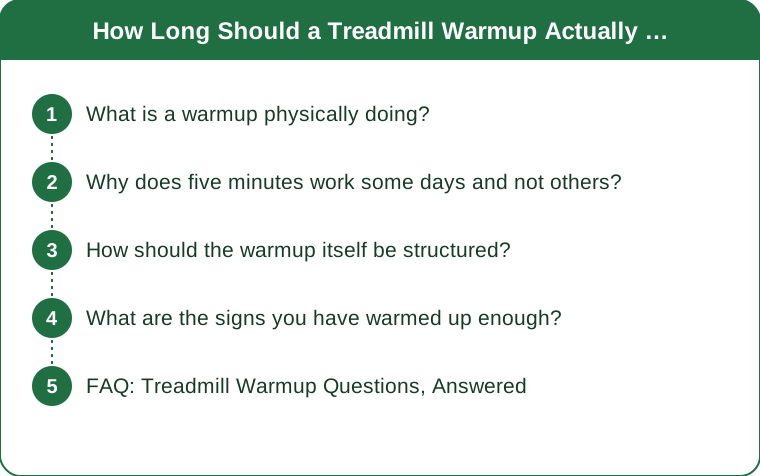
What is a warmup physically doing?
Raising muscle temperature, redistributing blood flow and waking up the coordination between them. That’s it — and each takes a different amount of time.
Muscle temperature rises slowly. Working muscle needs to climb a couple of degrees above resting, and at easy effort that takes several minutes of continuous work, not thirty seconds of leg swings. Warmer muscle is more compliant, contracts faster and produces more force at the same effort — which is why the first mile feels like a different body than the third.
Blood flow redistributes. At rest, a large share of cardiac output goes to your digestive organs and skin. During exercise it shifts toward working muscle, and that shift is not instant. The breathless, heavy feeling in the first few minutes of a run is largely this transition, not poor fitness.
Coordination sharpens. Running is a learned pattern, and the pattern runs sloppily when cold. Stride length, ground contact time and arm carriage all normalise over the first several minutes.
Why does five minutes work some days and not others?
Because starting temperature varies enormously and the five-minute rule assumes it doesn’t.
Room temperature is the biggest variable. A treadmill in a heated 22-degree room warms you far faster than one in an unheated garage at 12. In a cold space, the first five minutes are spent replacing heat you’re losing to the air rather than building any surplus — which is why garage sessions need roughly double the warmup of gym sessions.
Time of day matters more than most people expect. Core temperature follows a daily rhythm with a trough in the early hours and a peak in the late afternoon. A 6am run starts from a genuinely colder, stiffer body than a 5pm run, and the difference is worth five extra minutes.
Yesterday matters too. After a rest day, tissue is less pliable and the nervous system is less primed. After a run the previous evening, you’re already partly warm in the sense that matters — the coordination is fresh even if the muscles are tired.
And what you did before the session counts. Walking to the gym is a warmup. Sitting in a car for forty minutes and then stepping onto a belt is the opposite.

How should the warmup itself be structured?
As a ramp, not a flat block. A ramp does the same job in less time.
Start walking, not jogging. Two to three minutes of brisk walking at a slight incline — 2 to 4 percent — loads the calves and hamstrings gently and gets the temperature climbing without any impact.
Then ramp the pace every two minutes. Move from a walk to an easy jog to your intended easy pace in three or four steps rather than one. Each step should feel almost too easy when you make it.
Add strides only before fast work. Four to six accelerations of 15 to 20 seconds, at roughly the pace of your intended intervals, with full recovery between. These are what actually prepare you for speed — a slow ten-minute jog does not.
Save stretching for after, with one exception. Static stretching before running has been shown to temporarily reduce force output, and it doesn’t raise temperature. Dynamic movement — leg swings, walking lunges, high knees — is a reasonable addition if you’re particularly stiff, done after a few minutes of walking rather than cold.
What are the signs you have warmed up enough?
Three, and they’re all noticeable if you look for them.
Your breathing has settled at a pace that felt hard three minutes ago. That’s the blood flow redistribution completing.
Your stride feels automatic rather than deliberate. You’ve stopped thinking about your feet.
You’ve broken a light sweat, or you’re clearly about to. That’s the temperature signal, and it’s the most reliable of the three. In a cold room it may take fifteen minutes; in a warm gym in August it may take four. Trust the signal over the clock.
The opposite signs are equally clear. If the first interval feels disproportionately hard and the second feels easier, you started fast work cold. If your calves feel tight through the first ten minutes and fine after, the warmup was short.
Seasonal note: as mornings cool through September, the same 6am treadmill session in the same room starts from a lower temperature than it did in July, and the five-minute warmup that worked all summer quietly stops being enough. Most people notice this as ‘my easy pace feels harder lately’ and blame fitness.
FAQ: Treadmill Warmup Questions, Answered
Does the warmup count toward my workout distance?
Yes — it’s running, and it’s aerobic work at an easy intensity, which is exactly the majority of what most training should be. Count it.
Can I warm up too much?
You can tire yourself out before the session, particularly if the warmup drifts up in pace. If your warmup regularly leaves you needing recovery before the first interval, it’s too fast, not too long.
Is an incline warmup better than flat?
Slightly, for walking. A 2 to 4 percent incline at walking speed loads the posterior chain more evenly and raises heart rate faster than flat walking at the same speed. For the jogging portion it makes little difference.
What about warming up before a long slow run?
The first mile is the warmup. Start slower than target pace and let it come to you — no separate protocol needed.
Do I need a cooldown too?
A few minutes of easy walking helps you finish comfortably and is pleasant. Its benefits are smaller and less well supported than the warmup’s, so if you only have five spare minutes, spend them at the start.
This is general information, not medical advice. Persistent pain that a warmup does not resolve is worth having looked at.
TL;DR:
- A warmup raises muscle temperature, redistributes blood flow and sharpens coordination — each on its own timeline.
- Five to ten minutes easy, ten to fifteen before speed, up to twenty in a cold room or early morning.
- Ramp the pace in stages rather than holding one flat easy speed.
- Strides prepare you for fast work; slow jogging alone does not.
- The light sweat is a better signal than the clock — and it arrives later as mornings cool.
The five-minute rule is not wrong so much as unconditional. Match the warmup to the room and the hour and the first interval stops being the worst one.
Keep Reading
This article is for general informational and styling purposes only. Fit, sizing, and product availability may vary.