The Dreadmill Cure: Entertainment Engineering for Indoor Miles
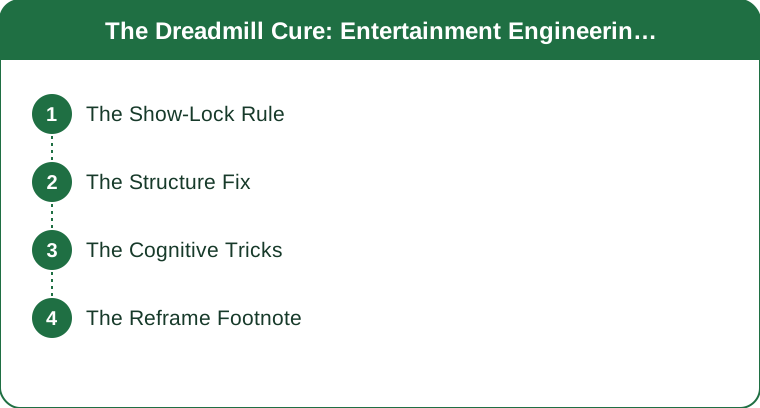
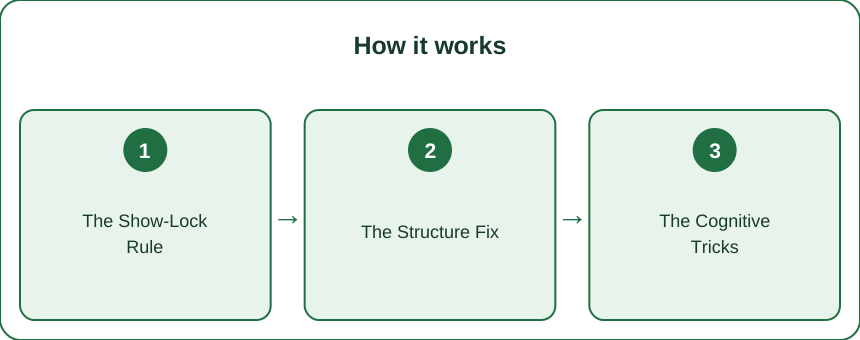
Quick Answer: Treadmill boredom is a design problem, not a willpower problem. The three fixes that work: lock one TV series to belt time only, so the cliffhanger schedules tomorrow’s session; run intervals instead of a steady pace, so 30 minutes becomes six 5-minute segments; and cover the console with a towel so you stop watching the clock. Structure beats discipline every time.
The treadmill’s real enemy was never the belt. It’s the clock, which runs measurably slower indoors than anywhere else in fitness.
You know the feeling. You look down convinced you’ve been running for twelve minutes. It’s been four.
The cures aren’t motivational. They’re engineering.

What’s the Single Best Cure for Treadmill Boredom?
Pick one TV series. Watch it only on the treadmill. Nowhere else, ever.
Behavioral researchers call this temptation bundling, and it’s one of the few adherence tricks with real evidence behind it. You’re pairing something you want to do with something you’d rather skip, and the want-to does the scheduling.
The mechanics matter more than people expect:
- Screen at eye height. Looking down at a propped phone wrecks your posture and your neck within two weeks.
- Episode queued before you step on. Fumbling with a login while walking is how people quit at minute two.
- Download it. Gym wifi has ended more workouts than sore hamstrings.
The cliffhanger does tomorrow’s motivating for you. The belt becomes the ticket price, and 45 minutes stops being a duration and becomes “one episode.”
How Do Intervals Fix Boredom?
Boredom feeds on sameness. Intervals starve it.
A steady 30-minute jog is one very long event. The same 30 minutes broken into segments is six short ones, and short ones are psychologically cheap.
Three structures worth stealing:
The incline rollercoaster. Same speed throughout, but change incline every 3 minutes: 1% → 4% → 2% → 6% → 1%. The legs get variety, the lungs get work, and you’re always 90 seconds from a change.
The speed pyramid. 2 minutes easy, 1 minute hard, 2 easy, 90 seconds hard, 2 easy, 1 hard, and back down. Roughly 20 minutes and it disappears.
The commercial-break challenge. Watching something with ads? Every ad break, bump the speed 0.5 mph or the incline 2% until the show returns. You are now being paid in interest by advertising.
Structured belt time passes in segments. Unstructured belt time passes in geologic eras.

What Nobody Tells You About the Console
The display is actively working against you.
Cover it with a towel. This is treadmill folklore precisely because it works — watched timers boil slower, and checking the clock every ninety seconds turns a workout into a countdown. Set the machine, drape the towel, and peek only when the show ends or the interval beeps.
Flip the countdown. If you must look, think in what’s left, not what’s done. “Ten to go” is a finish line; “twenty done” is a status report on an ongoing sentence.
Visualize a real route. Mentally walk a route you actually know — your old commute, a trail from a holiday, the loop around a childhood block. It’s oddly absorbing, and it eats minutes in a way that generic daydreaming doesn’t.
Match your audio to your pace. Podcasts and audiobooks suit steady walks and easy jogs; they fall apart during hard intervals, when you need something with a beat. Having both queued means one bad audio choice doesn’t sink the session.
When Should You Just Go Outside?
Here’s the honest footnote to all of this.
The treadmill is excellent as the weather option and the multitask slot — dark evenings, 95°F afternoons, thunderstorms, the 30 minutes you can only spare because a screen is nearby. It’s a poor daily default. Outdoor exercise reliably beats indoor for mood in the research, and there’s no console to cover when the scenery moves on its own.
So: outdoor days go outside. Belt days get the show.
The “dreadmill” was never the machine’s personality. It was entertainment-free time in a brain trained on constant input. Engineer the entertainment and the dread retires.
Frequently Asked Questions
Is walking on a treadmill as good as walking outside?
For cardiovascular benefit, close enough that it doesn’t matter — set the incline to 1% to roughly account for the missing air resistance. Outdoors adds terrain variation, sunlight, and a mood benefit that shows up consistently in studies. Indoors adds climate control and a screen. Both count.
How long should a treadmill session be?
Whatever length you’ll actually repeat. 20–30 minutes three to five times a week covers most general fitness goals, and the episode-length framing tends to land people at 40–45 without noticing. A session you finish beats a session you planned.
Why does the treadmill feel harder than running outside?
Partly heat — no breeze means you run warmer and your heart rate climbs faster. Partly boredom, which genuinely raises perceived effort. And partly the fixed pace: outdoors you unconsciously drift slower when tired, while the belt keeps its own opinion.
TL;DR:
- Lock one series to treadmill-only viewing; the cliffhanger schedules your next session.
- Screen at eye height, episode queued and downloaded before you step on.
- Intervals turn one 30-minute event into six cheap 5-minute ones.
- Cover the console with a towel and think “ten to go,” not “twenty done.”
- Set incline to 1% to approximate outdoor effort.
- Treadmill is the weather option, not the daily default — go outside when you can.
Keep Reading
This article is for general informational and styling purposes only. Fit, sizing, and product availability may vary.