Why Does the Treadmill Feel Harder in the Second Half of a Run?
Quick Answer: Heat is the main driver. Without airflow, your body temperature climbs steadily indoors, raising heart rate roughly 5 to 10 beats per minute for the same pace as a run progresses. Boredom, fixed cadence, and lack of visual motion cues add to the perception.
The first fifteen minutes are fine. By minute thirty-five at the exact same speed, you are checking the display every ninety seconds and considering whether the run was really necessary.
Outdoors at the same pace, that does not happen the same way. Here is what the machine is doing to you.
Why does heat build up more indoors?
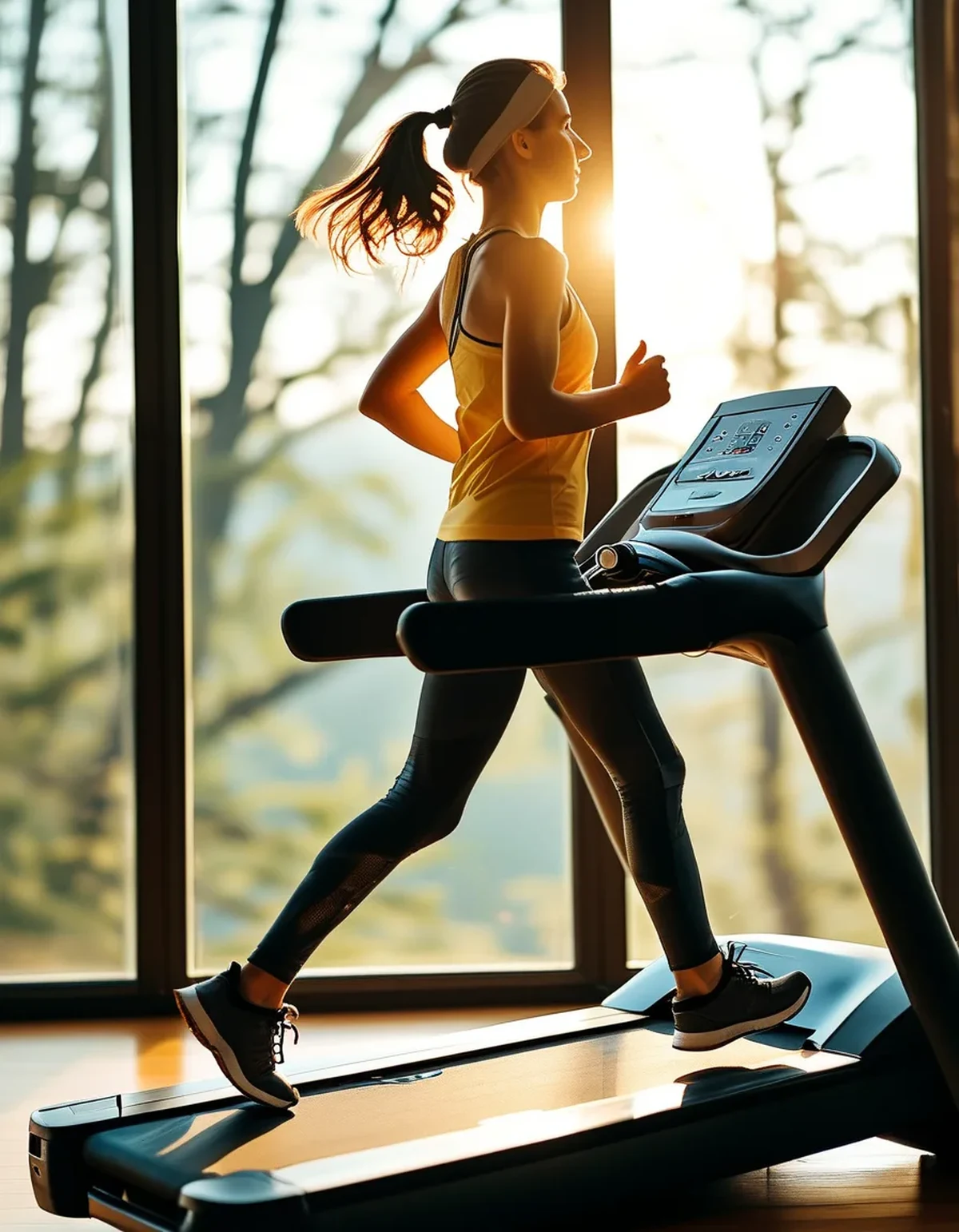
Because you are not moving through air. Outdoors, running generates airflow across your skin at your running speed, which drives convective and evaporative cooling continuously. On a treadmill you are stationary relative to the air, so that cooling mechanism is largely absent.
The consequence is a phenomenon called cardiac drift: at a constant workload, heart rate climbs steadily as core temperature rises and blood is redirected to the skin for cooling. Indoors without a fan, drift of 5 to 10 beats per minute over 30 minutes at unchanged pace is typical, and more in a warm room.
Your perceived effort tracks heart rate closely. So the run genuinely is harder in the second half — not because your fitness faded, but because your body is doing thermoregulation work on top of the running.
A fan directed at your torso is the single most effective intervention, and it is dramatically underused. It restores a large portion of the cooling you lose by staying in one place.
Does the treadmill actually require less effort than outdoors?
Slightly, and the difference is smaller than gym folklore suggests.
Outdoor running includes air resistance, which the treadmill removes. At typical recreational paces, this accounts for a small percentage of total energy cost — enough that a 1 percent incline is the commonly cited adjustment to match outdoor effort, though research suggests this matters mainly at faster paces, above roughly 7 minutes per mile.
The belt does not pull your legs backward for you in any meaningful way. Your legs still have to cycle, your body still has to support its weight on each stride, and the metabolic cost of that is nearly identical.
What does change is stride mechanics. Treadmill running tends to produce slightly shorter strides and higher cadence, and less hamstring involvement in the pull-through phase. Neither is harmful, but a runner who trains exclusively indoors may notice different muscle soreness when returning outdoors.
Why does time feel slower on a treadmill?
Several perceptual factors compound.
No visual motion. Outdoors, changing scenery provides continuous evidence of progress. On a treadmill the visual field is static, which removes the strongest natural distraction available and makes attention default inward — to your breathing, your legs, and the clock.
Fixed pace removes micro-variation. Outdoor running naturally varies with terrain, wind, and traffic. That variation is mentally engaging. A perfectly constant belt speed produces a perfectly constant sensation, which the brain habituates to and then finds tedious.
The display is right there. Having a clock in your visual field guarantees you check it. Studies on time perception consistently find that monitoring elapsed time makes it feel longer.
Reduced environmental input. Fewer sounds, smells, and temperature changes. Less to process means more attention available for discomfort.
What makes indoor runs meaningfully easier?
Address the heat first, then the monotony.
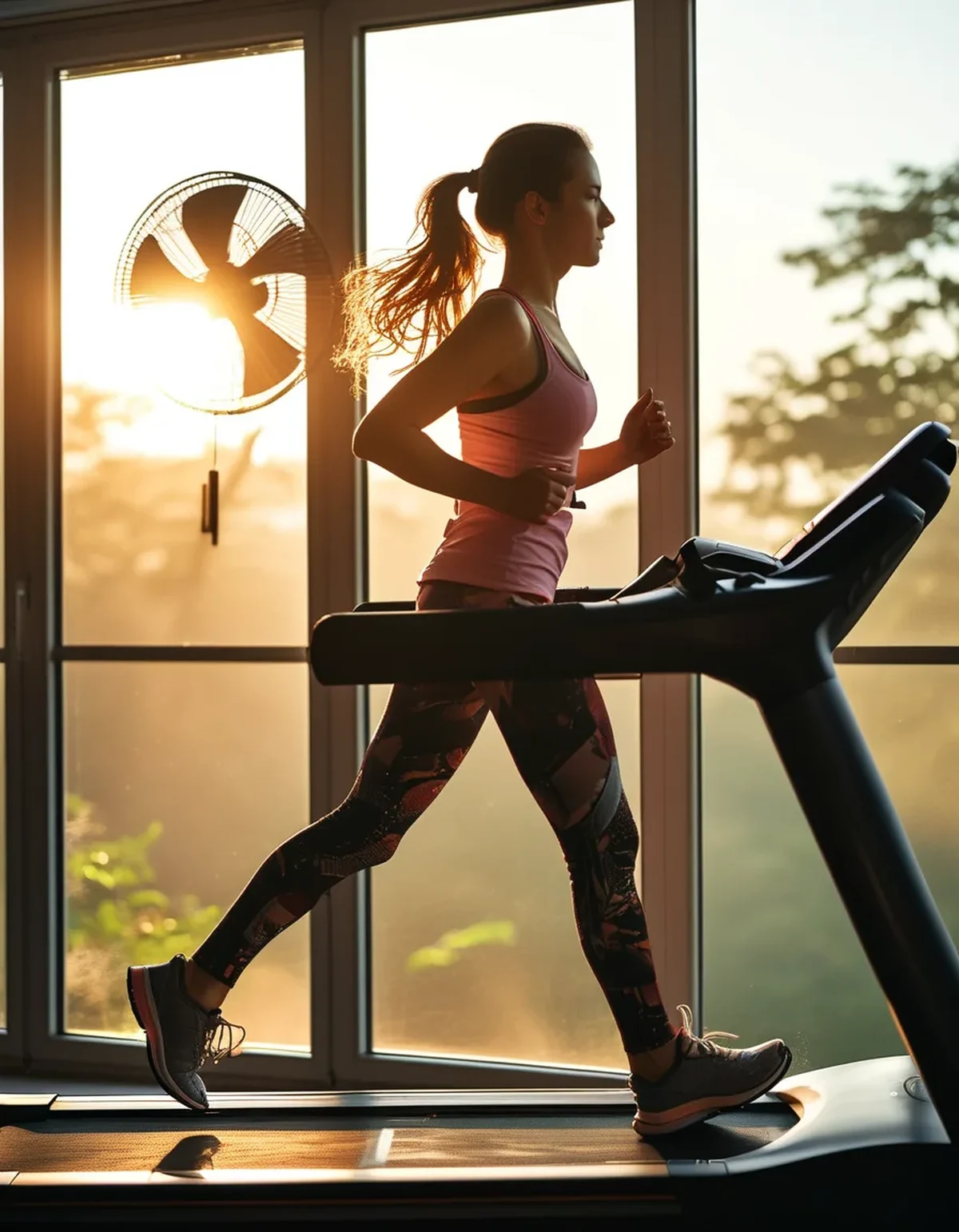
Use a fan, always. A standard floor or pedestal fan aimed at your chest. This is not a comfort preference — it directly reduces cardiac drift and lowers perceived effort at the same pace.
Lower the room temperature or open a window. Anything below about 68°F helps meaningfully.
Cover the display. A towel over the console removes the clock-checking loop entirely. Set an interval alarm on your watch instead so you know when to change something.
Build in variation every 5 minutes. Change speed by 0.2 mph or incline by 0.5 percent. It barely changes the physiological demand and it completely changes the psychological experience by giving you a series of short segments rather than one long one.
Hydrate during, not after. Indoor sweat rates can exceed outdoor rates in the same conditions because of the missing evaporative cooling. A few sips every 10 minutes helps.
Run at a slight incline as a default. 1 to 2 percent better matches outdoor mechanics and, usefully, engages more posterior chain, which changes the sensation enough to reduce monotony.
Is treadmill running worse for you than outdoors?
No, and in some contexts it is better.
The surface is more forgiving than concrete, which measurably reduces impact loading. For runners managing shin or knee irritation, this is a genuine advantage, not a consolation.
Pace control is precise, which makes it the best available tool for structured interval and tempo work. Holding an exact pace outdoors requires skill and flat terrain; indoors it requires pressing a button.
Incline training is available on demand. Sustained climbing at a controlled grade is difficult to replicate outdoors unless you live somewhere hilly, and it builds real strength.
Weather and safety are removed as variables, which for many people is the difference between running consistently and not.
The one genuine drawback is specificity. If you race outdoors, exclusively indoor training under-prepares you for uneven surfaces, wind, camber, and pacing judgment. A reasonable arrangement is to keep at least one outdoor run per week, ideally the long one.
This is general information, not medical advice. New or persistent pain during running deserves evaluation rather than a change in surface.
FAQ: Treadmill Running Questions, Answered
Should I always set a 1 percent incline?
It is a reasonable default and it better matches outdoor mechanics, but the evidence for it being necessary is strongest at faster paces. At easy paces, flat is fine — and if incline makes the run less likely to happen, flat is better.
Why is my heart rate higher indoors at the same pace?
Heat, almost always. Add a fan and re-test the same run — most people find the gap narrows considerably.
Is holding the handrails a problem?
Yes, more than most people realize. It reduces the work substantially, alters your posture and stride, and makes the displayed calorie and effort figures meaningless. If you need the rails to sustain the pace or incline, the setting is too high.
Do treadmill calorie readouts mean anything?
They are estimates based on speed, incline, and whatever weight you entered, and they generally run high. Useful for comparing one of your runs to another; not useful as an absolute number.
TL;DR:
- Missing airflow means heat builds steadily, driving cardiac drift of 5–10 bpm at unchanged pace.
- The belt does not do the work for you; the main real difference outdoors is air resistance, worth about 1% incline.
- Static visuals, constant pace, and a visible clock make time feel longer.
- Use a fan, cover the display, vary speed or incline every 5 minutes, and run at 1–2% incline by default.
The second half was harder because the room got warmer and nothing changed for forty minutes. Point a fan at yourself and put a towel over the console, and the same run turns back into the one you planned.
Keep Reading
This article is for general informational and styling purposes only. Fit, sizing, and product availability may vary.