Treadmill Speed vs Your GPS Pace: Why the Numbers Never Agree
Quick Answer: A treadmill console reports belt speed, which drifts with belt wear, tension, motor load, and your body weight. A GPS watch indoors has no satellite signal at all and estimates pace from arm swing, which it learned outdoors. Neither is measuring the same thing, so disagreement is normal rather than a fault. For consistent training, pick one number, calibrate it once, and stop comparing.
The console is usually closer to the truth. Your watch is guessing, politely.

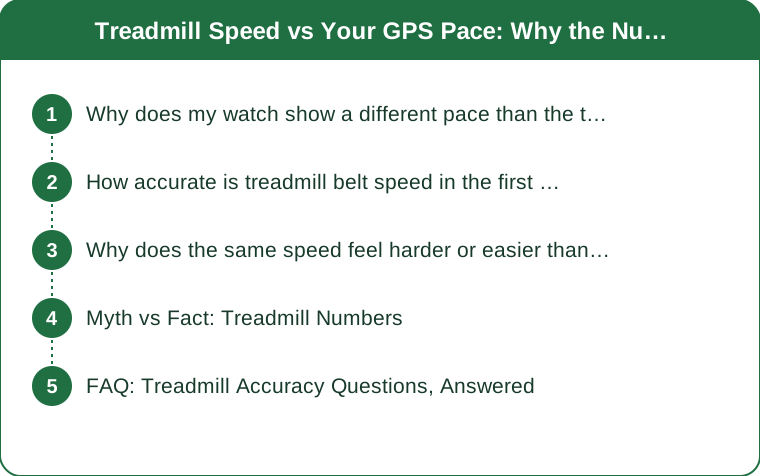
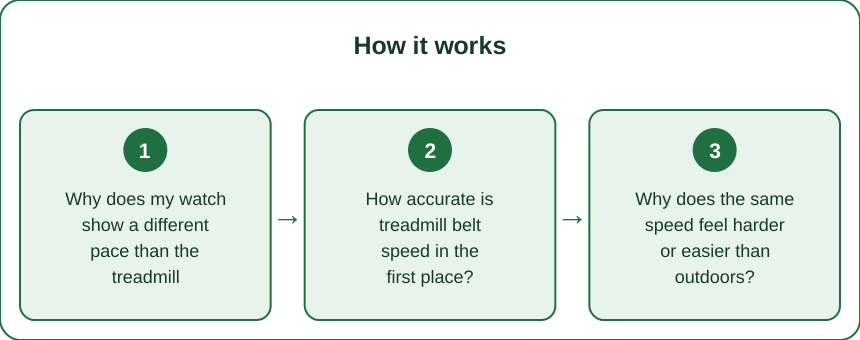
Why does my watch show a different pace than the treadmill console?
Because indoors, your watch is not measuring distance. It is inferring it.
GPS does not work indoors. There is no satellite fix inside a building, so the watch switches to an accelerometer-based estimate. It calculates pace from the cadence and acceleration pattern of your wrist, using a model built from your outdoor running.
That model has a specific weakness. It was trained on how your arm swings at a given outdoor pace, and treadmill running changes arm swing. Runners tend to hold a slightly shorter stride and a marginally different arm carriage on a belt, so the estimate skews.
Holding the handrails destroys the estimate entirely. If your wrist is not moving, the watch has almost nothing to work from, and reported distance collapses.
The console, meanwhile, reports belt speed — a mechanical figure derived from motor or roller rotation. It is a genuine measurement of the belt, not of you, and it has its own drift.
Watches with a foot pod are much better indoors, because a sensor on the shoe measures actual foot movement rather than arm proxy. Most watches also learn from outdoor runs over time, which is why indoor accuracy improves after a few months of mixed training.
Which number should I actually log?
The console, in most cases, and consistently. A slightly wrong number used every session still shows progress correctly, whereas alternating between two sources makes every comparison meaningless.
Does treadmill brand matter?
Commercial gym machines are generally serviced and calibrated on a schedule. Home machines drift more, since nobody calibrates them until something feels off.
How accurate is treadmill belt speed in the first place?
Reasonably, when new and maintained. Less so as it ages.
Treadmill speed readouts are typically derived from roller or motor rotation, which is accurate as long as the belt is not slipping and the machine is not fighting for power.
Things that push the real belt speed away from the displayed number:
Belt tension. A loose belt slips under foot strike, and the belt momentarily moves slower than the readout claims. Slipping under load is the most common source of real-world error and it is also the easiest to detect, because it feels like a stutter under your foot.
Lubrication. A dry deck increases friction dramatically, forcing the motor to work harder to hold speed. On underpowered machines it may not fully hold it.
Motor power versus user weight. A heavier runner loads the belt more on each foot strike. A low-powered motor may sag slightly under load and recover between strikes, producing an average belt speed a little below the display.
Wear. An old belt and worn rollers change effective circumference, which shifts the calibration constant the machine was set with at the factory.
Incline. Some consoles report a speed and a pace that already assume flat running. Adding incline changes your effort dramatically while belt speed stays the same.
How do I check whether my belt speed is honest?
Mark the belt with a piece of tape, set a slow speed, and count revolutions over 60 seconds with nobody on it. Belt length times revolutions gives distance per minute. It is crude, it takes five minutes, and it catches large errors.
Does the same drift affect distance and calories?
Distance, yes, because it is speed times time. Calorie figures are estimates layered on top of that, and they are far less reliable than either number.

Why does the same speed feel harder or easier than outdoors?
Because effort and belt speed are not the same variable.
There is no air resistance indoors. Outdoors you push through still air at your running speed, and that costs energy — a small but real fraction at easy paces and more as you get faster. Indoors that cost disappears, which is where the familiar advice about a 1% incline comes from.
There is no wind, no terrain variation, and no camber. Outdoor running constantly varies stride and loading. The belt is perfectly consistent, which reduces variety and increases repetition on the same tissues.
Heat changes the perception enormously. Outdoor running carries a constant cooling breeze created by your own motion. On a treadmill in a warm room, you generate the same heat with none of that airflow, so heart rate climbs at an identical belt speed. On a hot day indoors, the same pace can feel a full effort level harder for purely thermal reasons.
Your visual field does not move. Perceived exertion is partly informed by optic flow, and a stationary view makes effort feel more monotonous and often harder.
Which means chasing outdoor pace equivalence is the wrong goal. Effort is the thing that transfers, not the number, and matching heart rate or perceived exertion between indoor and outdoor sessions is far more useful than matching pace.
Should I set 1% incline to match outdoors?
It is a reasonable default at faster paces and largely unnecessary at easy jogging speeds. If it makes the run feel more like outdoors to you, use it; if it aggravates a calf or an Achilles, do not.
Why is my heart rate higher indoors at the same pace?
Usually heat and lack of airflow. A fan pointed at you removes most of that gap and is the highest-value treadmill accessory there is.
Myth vs Fact: Treadmill Numbers
Myth: A GPS watch is more accurate than the treadmill. Fact: Indoors your watch has no GPS at all and is estimating from arm movement. The console is measuring something real. Outdoors the ranking reverses.
Myth: Treadmill distance is always short. Fact: It can be short or long depending on belt wear and tension. Old, loose belts under a heavy runner tend to overstate; there is no universal direction of error.
Myth: Calibrating your watch fixes indoor pace. Fact: It helps, and the underlying estimate is still a model of your arm swing. A foot pod fixes it properly.
Myth: If the numbers disagree, one of them is broken. Fact: They measure different things by different methods. Disagreement is the expected outcome, not a fault report.
Myth: The calorie readout is roughly right. Fact: It is a generic estimate that usually cannot account for your body composition or efficiency, and it is the least reliable number on the console.
FAQ: Treadmill Accuracy Questions, Answered
Should I trust the treadmill or my watch for logging runs?
The treadmill, and use it consistently. Consistency matters more than absolute accuracy for tracking training progress over weeks.
Why did my indoor pace suddenly get worse on my watch?
Check whether you started holding the handrail, changed arm carriage, or wore the watch on a different wrist. All three break the arm-swing model the estimate relies on.
How often should a home treadmill be calibrated or serviced?
Check belt tension and lubrication every few months of regular use, or whenever you feel a stutter or hesitation under your foot. Both affect real speed as well as machine life.
Does a foot pod really help?
Yes, substantially. It measures foot movement directly instead of inferring from your wrist, and it is the most effective fix for indoor pace accuracy on any watch that supports one.
TL;DR:
- Indoors your watch has no GPS and estimates pace from arm swing; the console measures belt rotation. They are different measurements.
- Belt speed drifts with tension, lubrication, wear, and motor load, so a home treadmill wanders more than a serviced gym machine.
- Effort transfers between indoors and outdoors; pace does not, largely because of missing airflow and air resistance.
- Pick one source, log it consistently, add a fan, and use a foot pod if indoor accuracy matters to you.
Mark the belt with tape and count revolutions for one minute. Five minutes now settles months of arguing with your watch.
Keep Reading
This article is for general informational and styling purposes only. Fit, sizing, and product availability may vary.