Your Treadmill Safety Questions, Answered
Quick Answer: Treadmill injuries are common enough that they consistently rank among the leading causes of home exercise equipment injuries, and the majority are preventable with four habits: always attach the safety clip, never step onto a moving belt, keep children and pets out of the room entirely rather than merely supervised, and maintain a clear runoff zone of at least six feet behind the machine. Friction burns from a moving belt are the signature injury and they’re most common in young children.
Most people who own a treadmill have never used the safety key. It hangs on the console, unused, for years. Here’s what actually matters and why.

Do I really need the safety clip every time?
Yes, and it’s the single most skipped safety feature in home fitness.
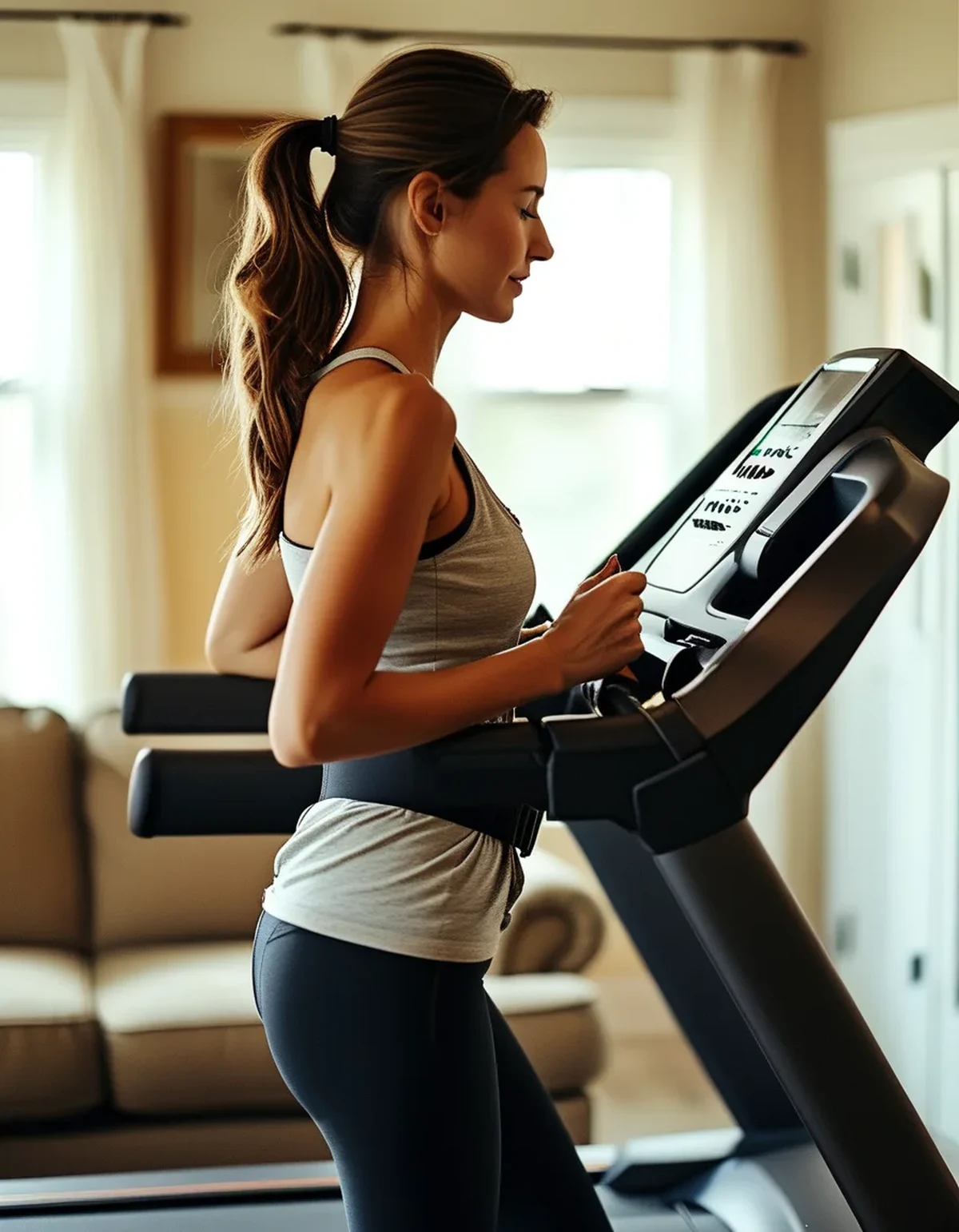
What it does: the magnetic key holds the belt running. Clip the cord to your clothing, and if you fall or move too far back, the key pulls free and the belt stops immediately.
Why it matters more than it seems: a treadmill belt does not stop when you fall. It keeps running, at speed, while you’re on it. The friction burn from a moving belt against skin can be severe — these are among the most commonly reported treadmill injuries in emergency department data, and they’re not minor scrapes.
The scenarios it prevents:
- A stumble at speed, where you go down and the belt continues
- Losing balance while reaching for a bottle or towel
- A medical event — dizziness, a stumble from lightheadedness — where you can’t reach the stop button
- Drifting backward gradually during a distracted run and running out of belt
Why people skip it: the cord is short, it’s easy to trigger accidentally, and nothing has ever happened. That last one is the dangerous reasoning.
If your clip is broken or missing: replacements are inexpensive and model-specific. Running without one because the original was lost is a fixable problem.
Practical habit: clip it before you press start, every time, as part of the same motion. Not as a separate decision you make each session, because that decision eventually goes the other way.
What’s the right way to get on and off a moving treadmill?
Never step onto a moving belt, and never step off while it’s at speed.
Starting:
- Stand on the side rails, one foot on each, straddling the belt
- Clip the safety key to your clothing
- Start the belt at the lowest speed
- Step on once the belt is moving slowly and steadily, one foot at a time, holding the handrails briefly
- Release the rails and increase speed gradually
Stopping:
- Reduce speed gradually to a walk
- Let it come to a full stop, or step onto the side rails first
- Then step off
What people actually do: jump on at 6mph, and jump off at 6mph onto the rails. Both are how ankles get injured. A moving belt under a foot that isn’t moving is exactly the mismatch that causes falls.
On holding the handrails: brief use while starting and stopping is correct. Holding them throughout a workout changes your gait, reduces the training effect substantially, and makes incline readings meaningless. If you need the rails to maintain the speed or incline, both are set too high.
Mid-workout adjustments: change speed and incline in small increments. Large jumps, especially in incline while at speed, are a common stumble trigger.
Getting a towel or bottle: slow down first. Reaching sideways at pace is one of the more common ways people lose balance, and it’s completely avoidable.
How dangerous are treadmills for children and pets?
More dangerous than almost any other item of home fitness equipment, and the injury pattern is specific.
The injury: friction burns to the hands, most often in children under five. A moving belt is fascinating to a small child, and touching it results in the hand being pulled into the gap between the belt and the roller. These burns are frequently serious, sometimes requiring skin grafts, and they occur most often while an adult is using the machine.
The critical detail: supervision is not enough. Most of these injuries happen with a parent in the room, on the treadmill, unable to stop the belt quickly enough. The belt-and-roller gap is unforgiving and the event takes a fraction of a second.
What actually works:
- Keep children out of the room entirely while the treadmill is in use. Not supervised — out. Close the door.
- Remove the safety key when not in use and store it out of reach. Without the key the belt won’t start. This is the most effective single measure and it takes two seconds.
- Unplug the machine between sessions if children are in the house.
- Use the console lock or child lock if the model has one, as a secondary measure.
- Never let children play on or near the treadmill, even when it’s off — it normalizes proximity.
For pets: the same principles. Dogs and cats are attracted to movement and can be caught by the belt or startled into the moving mechanism. Tails and paws are the usual injuries. Keep the room closed.
Placement matters too. A treadmill in a shared living space is a treadmill children will be around. A dedicated room with a closable door is meaningfully safer than any behavioral rule.
This is general information. If a friction burn occurs, seek medical assessment — these injuries are frequently deeper than they appear.
How much space do I need around the machine?
More behind it than most home setups have, and that clearance is the actual safety margin.
Behind the treadmill: most manufacturers specify a minimum clearance zone, commonly around 6 feet, and there’s a straightforward reason. If you fall or are thrown off, you travel backward at belt speed. A wall, a piece of furniture, or a doorframe within that distance is what turns a fall into an injury.
In practice: many home treadmills are pushed against a wall with a few feet behind. If that’s your situation, the practical compensations are running at lower speeds, using the safety clip without exception, and being honest that the margin is reduced.
On the sides: roughly 2 feet each side, so you can step off safely and so there’s nothing to catch a hand on during a stumble.
Above: enough that your head clears comfortably, including with incline raised and while running with normal vertical movement. Low basement ceilings are a genuine issue, and incline compounds it — a machine at 12 percent incline raises your head position considerably.
Flooring: a mat under the machine reduces vibration, protects the floor, and reduces static buildup. It also keeps the machine from creeping across a hard floor, which happens more than people expect.
Cable and cord management: the power cord should run where it can’t be stepped on or tripped over, and never under the belt.
Other things to remove from the immediate area: free weights on the floor behind or beside the machine, and anything on a shelf directly above it. Both are common home-gym arrangements and both are hazards in a fall.
What should I do if the belt slips, sticks, or the machine acts up?
Stop using it and diagnose, rather than working around it. Belt problems are the mechanical cause behind a meaningful share of falls.
Belt slipping — hesitating or losing traction under your foot:
- Usually a belt that’s too loose or a worn drive belt
- Stop using the machine until it’s addressed. A slip at speed is a fall.
- Tensioning is usually a simple adjustment with the supplied hex key, turning the rear roller bolts a quarter-turn at a time, equally on both sides
Belt drifting to one side:
- A tracking issue, adjusted with the same rear roller bolts — tighten the side the belt is drifting away from, in small increments
- Left uncorrected, the belt frays against the frame and eventually seizes
Belt sticking or jerking:
- Often insufficient lubrication between the belt and the deck. Most treadmills require silicone lubricant applied periodically — check your manual for the interval, commonly every 3 to 6 months for regular use.
- A dry deck also overheats the motor and dramatically shortens the machine’s life
Burning smell, or the motor cutting out:
- Stop immediately and unplug. This can indicate motor or controller failure and is a genuine fire risk.
- Common causes are a dry deck creating excessive friction, or dust buildup inside the motor cover
Console cutting out or speed fluctuating unexpectedly:
- Check the safety key contact and the power connection first
- Persistent electrical faults warrant a service call rather than continued use
Routine maintenance that prevents most of this:
- Vacuum under and around the machine monthly — dust in the motor compartment is the leading cause of premature failure
- Wipe the belt and deck after sweaty sessions
- Check belt tension and tracking every couple of months
- Lubricate on the manufacturer’s schedule
- Keep the machine unplugged when not in use
The general rule: a treadmill that’s behaving unusually gets diagnosed before it gets used again. The mechanical failures announce themselves first, and they’re cheap to fix at that stage.
FAQ: More Treadmill Safety Questions
Is it safe to use a treadmill while pregnant?
Walking on a treadmill is commonly considered appropriate during pregnancy for those already active, but balance changes as pregnancy progresses and the fall risk rises. Use the safety clip without exception, keep speeds conservative, and use the handrails as needed. Discuss your specific situation with your healthcare provider — this is one where individual guidance matters.
Can I watch shows or use my phone while running?
Walking, generally yes. Running at speed, it meaningfully increases stumble risk — distraction is a factor in a lot of treadmill falls. If you’re going to watch something, mount it at eye level rather than holding it, and keep the phone off the belt entirely.
Should I run barefoot or in socks on a treadmill?
No. Socks on a belt are slippery, and bare feet against a moving belt surface cause friction injuries and blisters quickly. Shoes with good traction, always.
What’s the most common treadmill injury?
Friction burns and abrasions from contact with the moving belt, followed by sprains and fractures from falls. Both are largely addressed by the safety clip, correct mounting and dismounting, and adequate clearance behind the machine.
TL;DR:
- Clip the safety key before you press start, every session — the belt does not stop when you fall.
- Never step onto or off a moving belt; straddle the rails, start slow, and step on once it’s moving steadily.
- Keep children and pets out of the room entirely, and store the safety key out of reach when you’re done.
- Keep about six feet clear behind the machine, and stop using it the moment the belt slips or sticks.
This is general information, not medical advice.
Keep Reading
This article is for general informational and styling purposes only. Fit, sizing, and product availability may vary.