Why You Overheat on a Treadmill When You Never Do Outside
Quick Answer: Running outdoors creates airflow across your skin equal to your running speed, and that moving air carries away most of the heat you produce. On a treadmill you generate the same heat while standing still in one spot, so it accumulates - your core temperature climbs, your heart rate drifts up, and the same pace feels harder. A fan is not a comfort accessory. It is the missing half of the equation.
You are producing exactly as much heat as you would outside.
You have simply stopped moving away from it.
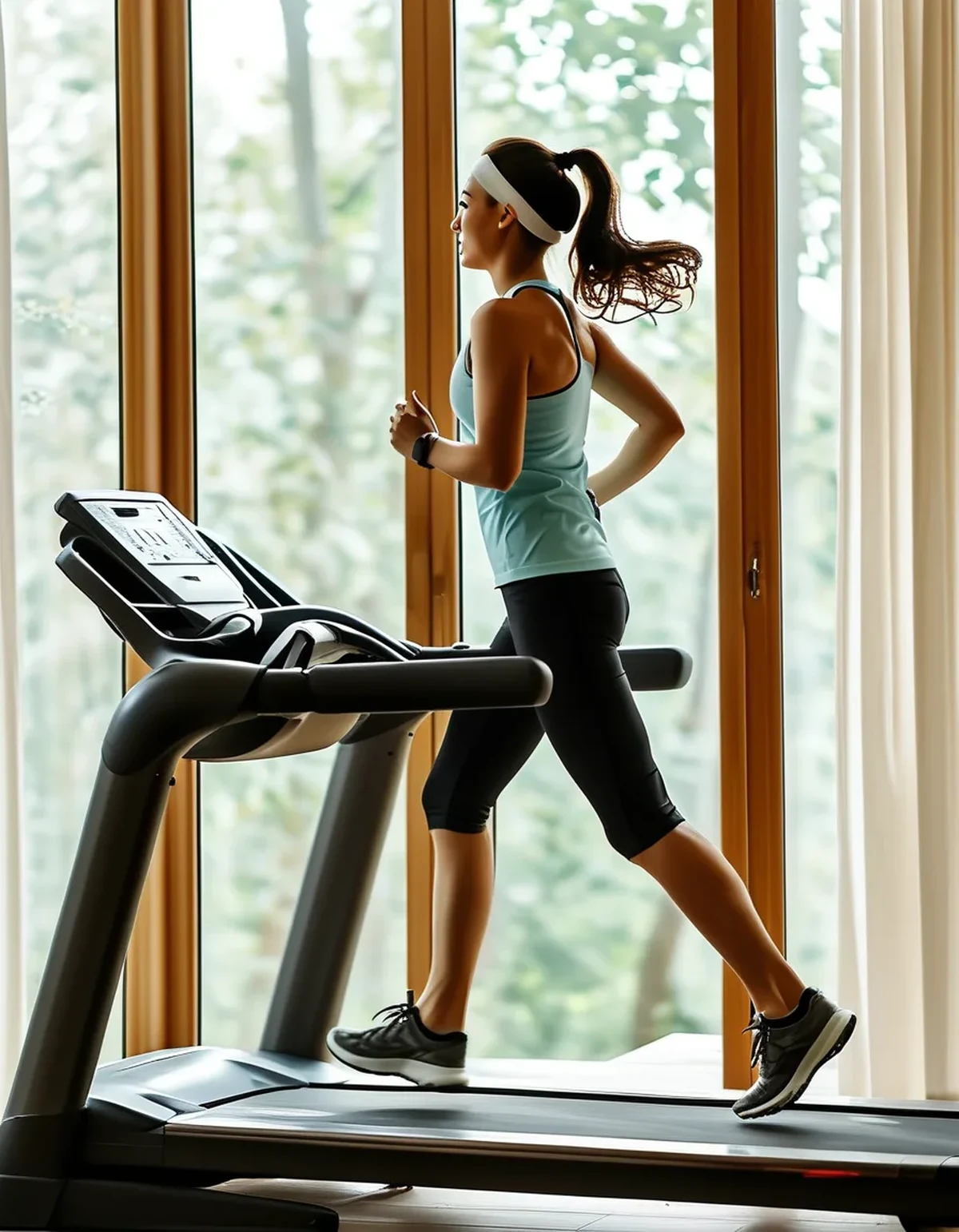
Why does standing still make so much difference?
Because the majority of the cooling you get outdoors is airflow, and indoors there is none.
Where does the heat actually go when you run outside?
Most of it leaves through evaporation of sweat from your skin, and evaporation depends heavily on air moving across that skin. Running at a moderate pace outdoors creates a constant breeze at exactly that speed, and that breeze is doing continuous work you never notice.
And on a treadmill?
You produce identical heat and stay in one place. The air immediately around you becomes warm and humid, sweat evaporates far more slowly, and heat builds up rather than dissipating. The room may be cool while the air touching your skin is not - that thin layer is what matters.
Is that why my heart rate climbs at a steady pace?
Largely, yes. As core temperature rises, more blood is directed toward the skin for cooling, leaving less available for the working muscles. Your heart compensates by beating faster to maintain output. This upward drift at an unchanged pace is the classic signature of a heat problem, not a fitness problem.
So the treadmill is not actually harder?
Mechanically it is arguably easier, since the belt assists slightly and there is no air resistance to push through. Thermally it is considerably harder, and thermal load is what most people are actually feeling when they say indoor running is tougher.
Does this explain the second-half fade?
It explains a great deal of it. Heat accumulates over time rather than appearing at once, so the first ten minutes feel fine and minute twenty-five does not. The fade is the accumulation curve made subjective.
How should a fan actually be positioned?
Placement changes the result more than fan size does.
Where should the fan point?
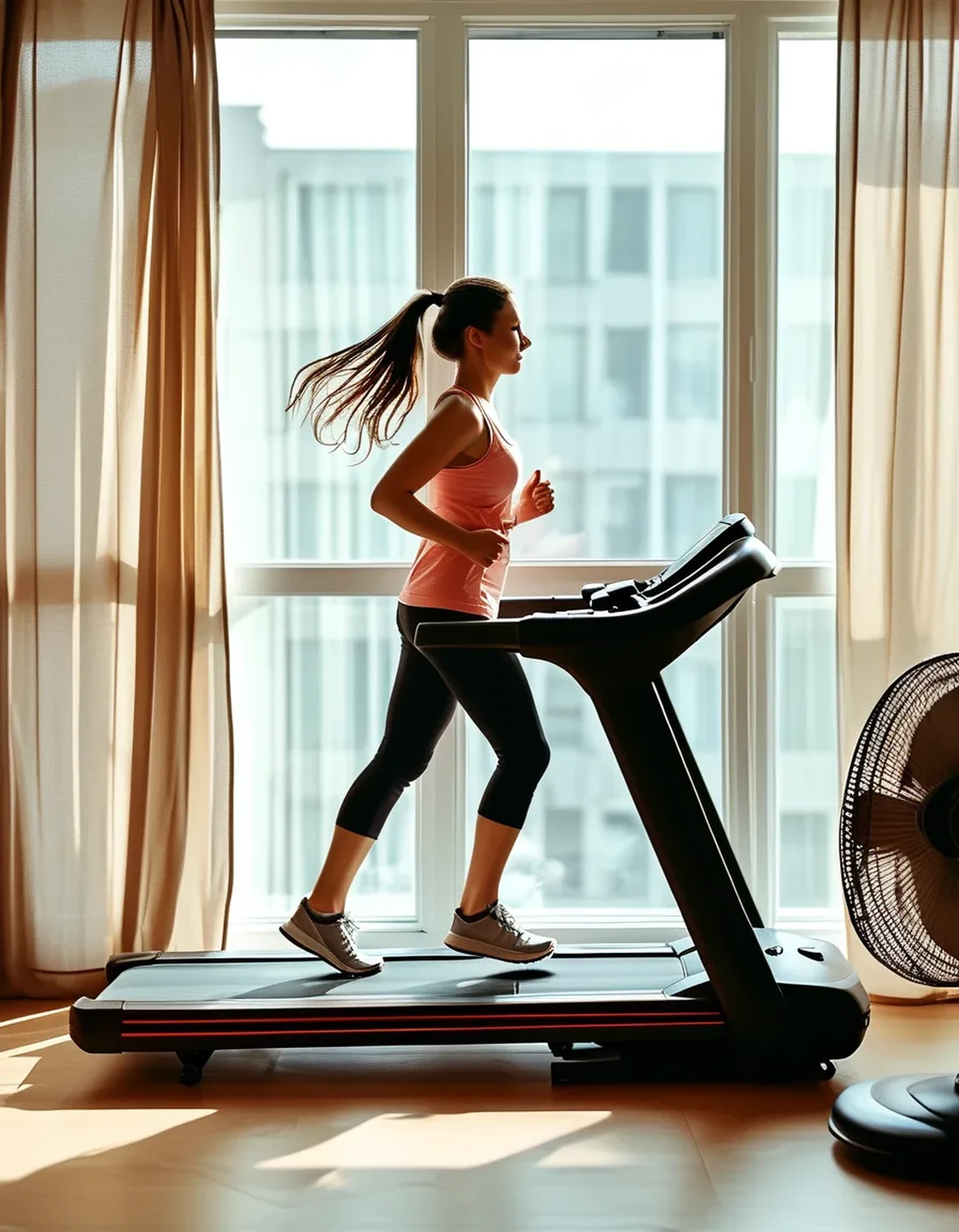
At your torso and head, from the front. Your chest, back, and head carry a large share of sweat output and blood flow near the surface. A fan aimed at your legs is largely wasted - it is cooling the part with the least benefit.
How high should it be?
Roughly chest height or slightly above, angled up toward your face. Floor fans blasting your shins are the most common mistake in home gyms. Elevate it on a box or bench if it will not tilt far enough.
How far away?
Close enough that you clearly feel moving air on your face and chest - typically a few feet. If you cannot feel it on your forehead, it is not doing the job, no matter how loud it is.
Does one fan do it, or do I need two?
One well-placed fan in front handles most of it. A second aimed at your back is a genuine upgrade for longer or harder sessions, because your back is against still air the whole time. Front first, back second if you are adding one.
What about opening a window instead?
An open window helps by lowering the humidity of the room and clearing warm air, but it does not create airflow across your skin unless there is a real breeze. Window and fan solve different halves of the problem - use both when you can.
Does the treadmill’s built-in fan count?
Rarely. Console fans are typically underpowered and aimed at nothing useful. Treat it as a bonus, not the solution.
What else raises the indoor heat load?
Several factors stack, and most are easy to change.
Does room size matter?
Substantially. A small enclosed room warms and humidifies quickly from one person exercising, and after twenty minutes you are running in air you have already heated. Basements and spare bedrooms are the usual offenders, and cracking the door alone helps.
What about what I am wearing?
More than people expect. Fabric that holds sweat rather than moving it away keeps a wet layer against the skin that cannot evaporate. Lighter, looser, moisture-moving fabric is the indoor default - the outfit that works for a cool outdoor run is often too much indoors.
Does time of day matter?
Yes, especially in late summer. Rooms hold afternoon heat well into the evening, so an eight p.m. session in an upstairs room can be considerably hotter than a seven a.m. one. Same workout, different thermal starting point.
Should I change my pace to account for it?
Running to effort or heart rate rather than pace is the honest approach indoors, particularly in a warm room. The pace that matches a given effort will be slower indoors, and treating that as a fitness failure is a misreading.
Does hydration change any of this?
It does. Sweat losses are typically higher indoors because evaporation is less efficient and the session runs hotter. Have water within reach, and expect to want more of it than for an equivalent outdoor run.
When is it more than heat?
Dizziness, nausea, chills while still hot, or confusion are not the ordinary discomfort of a warm room. Stop, cool down, and hydrate - and if symptoms persist or recur, get it looked at. This is general information, not medical advice.
Myth vs Fact: Treadmill Running Beliefs
Myth: sweating more means you worked harder. Fact: sweat rate tracks heat load and airflow far more than effort. You can sweat through a shirt in a hot still room at an easy pace, and barely sweat at a hard pace in a breeze.
Myth: the treadmill is easier so it does not count. Fact: the mechanics are slightly easier, the thermal load is meaningfully harder, and the physiological cost is often similar or higher. Different, not lesser.
Myth: a one percent incline fixes the difference. Fact: incline was proposed to match the missing air resistance, which is a small effect at most speeds. It does nothing at all about heat, which is the far larger factor.
Myth: you get used to the heat and it stops mattering. Fact: heat acclimation is real and does help, but it takes consistent exposure and does not remove the underlying load. Acclimation is not a substitute for a fan.
Myth: a cold room means no heat problem. Fact: the air temperature of the room is not the same as the air against your skin, which is warm, humid, and unmoving without airflow. Still air in a cold room still traps heat.
Myth: the drink holder is enough hydration planning. Fact: most people underdrink indoors because they are not thinking about it. Deciding on an interval before you start works better than sipping when it occurs to you.
FAQ: Indoor Running Heat Questions, Answered
How much fan do I actually need?
Enough to feel clearly on your face at running distance - a decent pedestal or floor fan on a stand is plenty for most rooms. Placement beats power, so try repositioning what you own before buying anything.
Why do I feel worse for longer after an indoor run?
Because you finish with a higher core temperature and stop moving in the same warm room. Keep the fan on for five minutes after you stop, and the recovery is dramatically faster.
Should my indoor easy pace be slower than outdoors?
Almost certainly, and that is correct rather than a problem. Run easy days by effort or heart rate, and let the pace be whatever the conditions allow.
TL;DR:
- Outdoor running gives you free airflow at your running speed - a treadmill removes it entirely.
- Heat accumulates rather than dissipating, which is why heart rate drifts up at an unchanged pace.
- Aim the fan at your chest and face from the front, at roughly chest height, close enough to feel.
- Small rooms, evening heat, and heavy fabric stack on top of the core problem.
- Run indoors by effort, not pace, and keep the fan running for five minutes afterwards.
Before your next indoor run, move your fan up to chest height and point it at your face instead of your legs. Same workout, and you will notice the difference inside ten minutes.
Keep Reading
This article is for general informational and styling purposes only. Fit, sizing, and product availability may vary.