How Your Running Form Actually Changes Between Treadmill Speed Work and Incline Work
Quick Answer: High-speed treadmill running shifts your form toward a forefoot strike, shorter ground contact, and forward lean, while incline work shifts you toward a flatter foot strike, shorter stride, and more upright torso with active knee drive — treating them with the same form leads to either overstriding on inclines or excessive heel strike at speed.
Runners who nail one workout often bomb the other because they never adjust their mechanics between them. The treadmill belt doesn’t care, but your joints absolutely do.

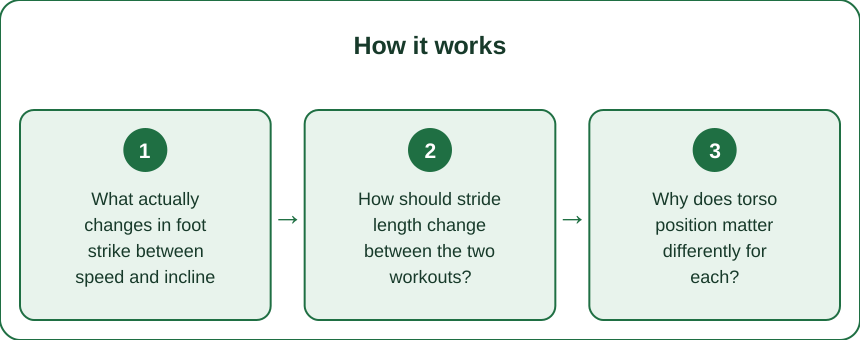
What actually changes in foot strike between speed and incline work?
At high speed, momentum favors a forefoot or midfoot strike with a quick, light ground contact time, since the belt is already moving fast under you and a heel-first landing at that speed creates a harsh braking force. On an incline, a flatter, fuller foot strike works better because the angled surface already shortens your effective stride, and a forefoot-only strike on a steep incline increases calf strain unnecessarily.
How should stride length change between the two workouts?
Speed work rewards a slightly longer, more powerful stride driven by hip extension, while incline work should shorten your stride significantly — trying to maintain a flat-ground stride length on a 6-8% incline is one of the most common form breakdowns, since it overextends the front leg and increases knee strain with each step.

Why does torso position matter differently for each?
For speed intervals, a slight forward lean from the ankles (not the waist) helps use gravity to assist turnover. For incline work, staying more upright with active knee drive keeps your center of mass over your feet on the angled surface — leaning too far forward on an incline, a common mistake, actually makes the climb harder by fighting your own balance.
What Nobody Tells You About Switching Between Speed and Incline in the Same Session
Doing a combined workout (say, speed intervals followed by an incline finisher) without a brief transition means your body is still primed for one mechanic pattern when you switch to the other — a 30-60 second walk at zero incline between the two workout types lets your stride, foot strike, and cadence reset, which measurably reduces the awkward first minute of the new segment where form is at its sloppiest.
FAQ: Treadmill Speed vs Incline Form Questions, Answered
Is it normal for cadence to drop on an incline compared to flat running?
Yes — cadence naturally decreases slightly on inclines because each step covers less horizontal distance; forcing your flat-ground cadence on a steep incline usually leads to overstriding, not better performance.
Should arm swing change between speed and incline work?
Somewhat — speed work benefits from a tighter, faster arm swing that matches leg turnover, while incline work benefits from a more driving, slightly wider arm swing that helps generate power on each uphill step.
Can bad incline form actually cause injury over time?
Yes — consistently overstriding on inclines increases strain on the hip flexors and lower back, since the body compensates for the mismatch between stride length and the angled surface; shortening your stride on inclines is a simple, high-value fix.
TL;DR:
- Speed work favors a forefoot strike, longer stride, and forward lean from the ankles
- Incline work favors a flatter strike, shorter stride, and upright posture with knee drive
- Give yourself a brief flat-ground reset between the two when combining them in one session
- Overstriding on inclines is the most common and most fixable form mistake Your treadmill doesn’t force good form on its own — matching your mechanics to the workout type is what actually keeps speed days fast and incline days safe.
Keep Reading
This article is for general informational and styling purposes only. Fit, sizing, and product availability may vary.