Does Holding the Treadmill Handrails Really Ruin Your Workout?
Quick Answer: Holding the handrails transfers part of your body weight into your arms, which is why the calorie readout stays high while the actual effort drops — on a steep incline the difference can be substantial. It is not automatically wrong: holding is reasonable for balance, medical reasons, or brief stability checks, and unhelpful when it is the only way you can sustain your chosen speed or incline. If you need the rails to hold your setting, the setting is the problem.
Somebody at the gym told you to let go of the rails, in that tone. Then you let go and the workout got noticeably harder, which felt like proof they were right and also deeply annoying.
The honest version is more interesting than the lecture. The third section covers when holding on is genuinely the correct choice, which nobody ever mentions.

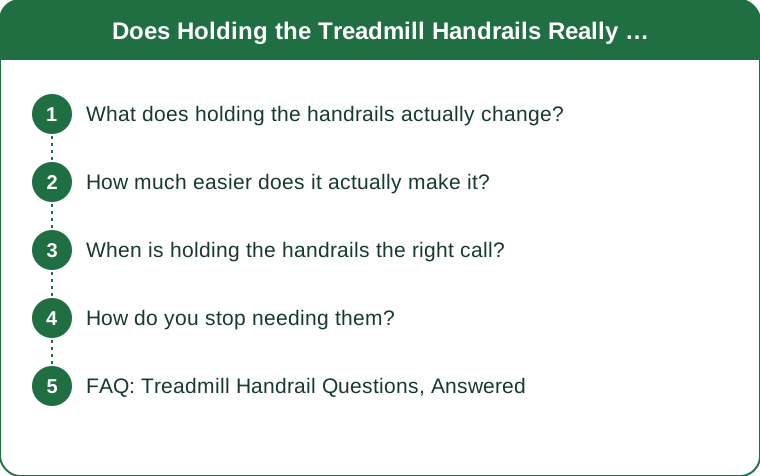
What does holding the handrails actually change?
It changes three measurable things.
It offloads body weight. When you lean on the rails, some portion of your weight goes through your arms into the frame instead of through your legs into the belt. Research on incline walking with handrail support has found meaningful reductions in oxygen cost compared with the same speed and grade hands-free. The steeper the incline, the bigger the offload, because the temptation to lean increases with grade.
It changes your posture. Reaching forward to grip the front rail pulls your torso forward and your hips back, which shortens your stride and reduces glute involvement. Gripping the side rails is less distorting but often still leads to a slight downward push.
It breaks your arm swing. Arm swing is not decoration. Counter-rotation between your arms and legs stabilizes your trunk and contributes to the rhythm of your stride. Pinning your arms means your core does less work and your gait pattern becomes less like actual walking or running.
The consequence is the one everybody has noticed: the console’s calorie estimate does not know you are holding on. It calculates from speed, incline, and the weight you entered. Offload thirty percent of your weight into the frame and the number on the screen keeps counting as if you had not.
How much easier does it actually make it?
It depends almost entirely on incline, and the pattern is worth knowing.
On flat ground at a moderate walking speed: very little. Light contact with the rails on a flat belt changes the metabolic cost only marginally. If you rest a hand lightly on the side rail while walking at 5 km/h on zero incline, you are not meaningfully cheating anything.
On a moderate incline — say 5 to 8 percent: now it matters. This is the range where the arms start meaningfully unloading the legs, and where a firm grip can drop the true effort by a noticeable margin while the console reports the same number.
On a steep incline — 10 percent and above: this is where the gap is largest. The popular 12-3-30 style workout is the classic case — the incline is steep enough that most people cannot sustain it without support, so they hold on, and the workout they are actually doing is substantially easier than the one on the screen.
Here is a simple field test. Set your usual incline and speed, hold on, then let go for thirty seconds. If letting go sends your breathing from conversational to gasping, you were getting a large assist. If it changes almost nothing, you were mostly resting your hands.
The heart rate check works too: let go and watch. A jump of 10 to 20 beats per minute within a minute means the rails were doing real work.

When is holding the handrails the right call?
More often than the internet suggests. There are legitimate reasons.
Balance conditions and neurological issues. If you have vestibular problems, peripheral neuropathy, or any condition affecting balance, rails are a safety feature, not a shortcut. The right adjustment is to reduce speed or incline so that the workout is honest at a level you can do safely — not to let go and risk a fall.
Early rehabilitation or return from injury. Light rail contact for confidence while regaining gait is standard practice in physical therapy settings.
Brief, deliberate checks. Reaching for a rail to adjust a setting, check a watch, take a drink, or steady yourself for a moment is fine. Nobody’s fitness is undone by five seconds of contact.
Very steep interval work where the goal is the legs. Some hill-sprint style protocols use rail support deliberately, treating the treadmill as a leg-drive tool rather than a whole-body cardio session. It is a valid choice as long as you know that is what you are doing.
When you are new and the treadmill is intimidating. Confidence first. Light fingertip contact while you get used to the moving belt is a completely reasonable transition step, and you can wean off it within a few sessions.
The problem is never contact. The problem is when the rails are the load-bearing structure of your entire workout and the console is telling you a story about calories that is not true.
How do you stop needing them?
Fix the setting, not the willpower.
Step 1: Find your honest incline. Drop the incline by 3 to 4 percent from wherever you currently need to hold on. Walk hands-free. If you can hold a conversation with slight effort, that is your real starting point. It will feel humbling. That is fine — the number on the console was never the point.
Step 2: Use fingertips as a bridge. If you are between fully hands-free and needing support, rest one or two fingertips on the rail rather than gripping. Fingertip contact provides balance feedback without meaningful weight transfer, and it is a genuinely useful intermediate step.
Step 3: Add incline back one percent at a time. Add a percent when you can complete your full session hands-free at the current setting. This usually takes two to four weeks per step, which sounds slow until you notice you are now doing at 10 percent what you previously faked at 12.
Step 4: Practice the arm swing deliberately. Let your arms swing naturally, elbows slightly bent, hands relaxed. It feels strange for the first few minutes and then becomes automatic.
Step 5: Shorten the session if you need to. Twenty honest minutes beats forty-five leaning minutes. Trade duration for integrity while you build the capacity back.
FAQ: Treadmill Handrail Questions, Answered
Does the calorie number really overestimate that much when I hold on?
Yes. The console has no sensor for how much weight is in your arms. It calculates from the speed, incline, and body weight you entered. On a steep incline with a firm grip, the real energy cost can be considerably lower than what is displayed. Use heart rate or perceived effort as your reality check instead.
Is it worse to hold the front rail or the side rails?
The front rail is generally worse, because reaching forward pulls your torso out of an upright position and shortens your stride. Side rails let you stay more upright, so if you need contact, prefer the sides — and use fingertips rather than a grip.
What about holding on during a cool-down?
Fine. Cool-downs are for lowering heart rate and easing the transition, not for maximizing effort, and light contact while your legs are tired is a reasonable safety choice. The same applies to the first minute while you find your rhythm.
TL;DR:
- Holding the rails offloads body weight into the frame, which lowers real effort while the console keeps counting as if it did not.
- The effect is small on flat ground and large on steep inclines — exactly where people hold on most.
- Rails are legitimate for balance conditions, rehab, brief adjustments, and confidence while you are new.
- If you need them to sustain your setting, lower the incline 3 to 4 percent and build back a percent at a time.
- Test yourself: let go for thirty seconds and watch your heart rate. That number is the truth.
The most useful reframe here is that the rails are not a moral failing, they are information. If you cannot let go, your machine is set beyond what you can currently do — which is worth knowing, and worth fixing slowly, rather than covering up with a grip and a very optimistic calorie readout.
Keep Reading
This article is for general informational and styling purposes only. Fit, sizing, and product availability may vary.