Cold Garage Treadmill Questions Everyone Asks in the First Cold Week
Quick Answer: Cold thickens the belt lubricant and stiffens the deck, so a garage treadmill in autumn needs a 5-10 minute slow warm-up at 3-4 km/h before you run, more frequent lubrication than the manual’s summer schedule, and a room above roughly 10C for the electronics to behave. Most first-cold-week faults are viscosity, not failure.
The belt stutters for the first minute.
The console takes three tries to wake up.
Your legs feel like they belong to someone heavier.
All three are the same story: things got cold.

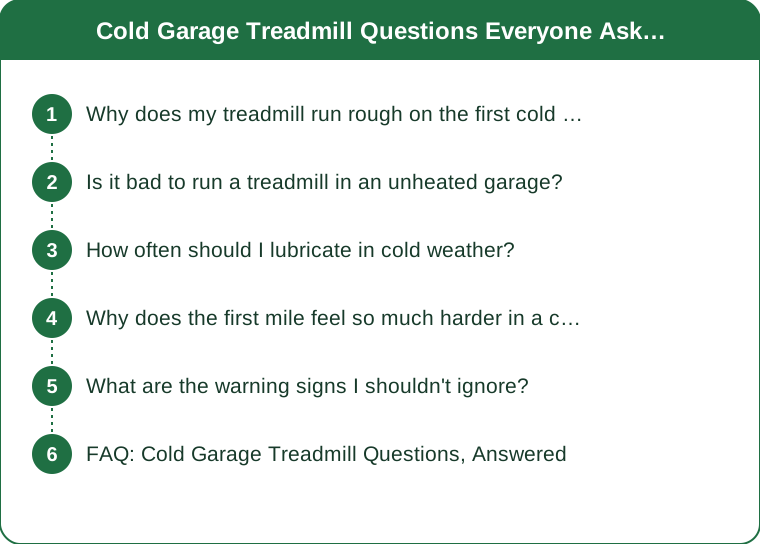
Why does my treadmill run rough on the first cold morning?
Because lubricant viscosity rises sharply as temperature falls, and your treadmill’s belt glides on a thin film of silicone between belt and deck. When that film thickens, the motor has to work harder to drag the belt, and you feel it as a stutter or a belt that seems to grab and release.
Three things follow from that.
The motor draws more current. Same speed, more resistance, more heat in the motor over time. On an older machine this is what pushes the motor from warm to genuinely hot on a long run.
The deck itself stiffens. Cushioning elastomers get firmer in the cold, which is why the deck feels harder underfoot in November than it did in July — and why your shins notice.
Belt tension shifts. Materials contract as they cool. A belt tensioned perfectly at 25C can sit slightly loose at 8C, which shows up as slipping under your push-off, especially on incline.
The fix is boring and effective: run the belt empty at 3-4 km/h for 5-10 minutes before you step on. That warms the lubricant film and the deck enough that everything behaves. Do it while you are doing your own warm-up and it costs you nothing.
Is it bad to run a treadmill in an unheated garage?
Not inherently — plenty of machines live in garages for years. But there are limits worth knowing.
Most consumer treadmills specify an operating range of roughly 10-35C. Below that, the console LCD gets sluggish and can display strangely, the lubricant is too thick, and condensation becomes a real problem.
Condensation is the actual danger, not cold. When cold metal meets warm humid air — you finishing a sweaty run, or a warm afternoon after a cold night — moisture forms on the circuit board and motor components. Repeated cycles of that cause corrosion. This kills more garage treadmills than cold ever does.
Three protections that matter:
- Cover it, but only when it is dry and cool. A cover over a warm machine traps moisture against it, which is worse than no cover.
- Ventilate during and right after your run. Cracking the garage door 15cm for the session and 20 minutes afterward lets the humid air out.
- Keep it off the concrete if you can. A rubber mat isolates the frame from the coldest, dampest surface in the room and cuts noise transmission at the same time.
How often should I lubricate in cold weather?
More often than the manual’s default, because the manual’s interval assumes a temperate indoor room.
A common baseline is every 60-100 kilometres, or roughly every three months for light use. In an unheated space, move toward the shorter end of that — the thicker the lubricant runs, the more the belt drags, and the faster the friction builds heat and wear.
The check takes ten seconds. Turn the machine off, slide your hand under the middle of the belt from the side. It should feel faintly slick, like a lightly waxed surface. If it feels dry or grabby, lubricate.
Use 100% silicone specified for treadmills. Not WD-40, not household oil, not a spray lubricant — those degrade the deck surface and can attack the belt backing.
Apply it warm. Bring the bottle inside the night before. Cold silicone spreads unevenly and you end up with a thick centre stripe and dry edges, which is worse than a uniformly slightly-dry belt.
Then run it empty at low speed for 3-5 minutes to distribute the film before you step on.

Why does the first mile feel so much harder in a cold room?
Two separate things stack, and only one is about you.
Your muscles are genuinely less efficient cold. Muscle contraction speed and force production both drop at lower tissue temperature, and joint synovial fluid is more viscous, so range of motion feels restricted. Your perceived effort at a given pace legitimately rises. This is not softness; it is physiology.
And the machine is harder to run on. A stiffer deck returns less energy, and a slightly draggy belt subtly changes your stride. Combined, the same 8:00/km that felt easy in August feels like work.
Four adjustments that fix it:
- Lengthen the warm-up by 5 minutes versus your summer routine. Walk, then very easy jog, then start the actual session.
- Judge the first 10 minutes by effort, not pace. Cold-start pace is not diagnostic of anything.
- Layer to shed. A long-sleeve you remove at minute 12 is better than starting cold and staying cold, because a cold start delays the warm-up further.
- Keep the fan off until you are warm. Cooling airflow on cold skin at minute two just extends the problem; it earns its place at minute fifteen.
What are the warning signs I shouldn’t ignore?
Cold explains most first-week oddities. These are not among them.
A burning or hot-plastic smell. Stop immediately. That is motor or controller heat, not cold weather, and continuing risks the board.
Belt slipping under load after a proper warm-up and lubrication. That is tension or a worn belt, and running on it damages the deck.
A console that resets mid-run. Electrical rather than thermal, usually. Check that it is on its own circuit and not sharing with a garage freezer or a compressor.
Visible moisture inside the console or on the motor cover after a session. Address the ventilation and covering routine now, before corrosion starts.
Grinding, clicking or a rhythmic thump. Bearings or a roller. It will not fix itself as the room warms.
A tripped breaker on startup. Cold-start current draw is higher, so a marginal circuit trips in November and never did in July. That is a real electrical constraint, not a treadmill quirk — get it looked at rather than resetting it repeatedly.
FAQ: Cold Garage Treadmill Questions, Answered
What temperature is too cold to run my treadmill?
Below roughly 10C you are outside most manufacturers’ stated operating range. It will usually still work, but with sluggish displays and thick lubricant.
How long should I warm the machine up?
5-10 minutes empty at 3-4 km/h. Do it while you warm yourself up.
Can I use a space heater in the garage?
Yes, and run it for 20-30 minutes before you start rather than during. Never point it directly at the motor housing or leave it unattended.
Does cold weather void my warranty?
Operating outside the stated temperature range can affect coverage on some machines. Worth reading your specific manual before an unheated winter.
Should I cover the treadmill in the garage?
Only when it is cool and dry. Covering a warm, damp machine traps moisture against the electronics.
Why does the belt slip only on incline now?
Cold contraction can leave tension slightly low. If it persists after warm-up and lubrication, adjust tension per the manual — a quarter turn at a time, both sides evenly.
Is running in a cold garage bad for me?
No, with a longer warm-up and layers you can shed. Cold-weather exercise is fine for most people, though anyone with asthma or a heart condition should talk to their own clinician about cold-air exercise. This is general information, not medical advice.
TL;DR:
- Cold thickens the lubricant and stiffens the deck — that is the stutter, the hard feel and the extra motor load.
- Run the belt empty at 3-4 km/h for 5-10 minutes before every cold session.
- Lubricate more often in an unheated space, with warm 100% silicone, and check by hand under the belt.
- Condensation, not cold, kills garage treadmills — ventilate, and only cover when cool and dry.
- Add 5 minutes to your own warm-up and judge the first 10 minutes by effort, not pace.
Do the empty-belt warm-up this week. Half the first-cold-week complaints disappear on their own.
Keep Reading
This article is for general informational and styling purposes only. Fit, sizing, and product availability may vary.