Why Your Treadmill Belt Slips Under Your Feet Mid-Run (And the Real Fix)
Quick Answer: Belt slipping under your feet mid-run is most often caused by insufficient belt tension or a lack of lubrication between the belt and the deck underneath it — both are home-fixable maintenance issues that take under 15 minutes, rather than a sign the treadmill motor or belt itself needs replacing, which is what many people assume first.
A slipping belt gets blamed on the treadmill being old or low-quality, when it’s frequently just a routine maintenance item that’s been skipped.

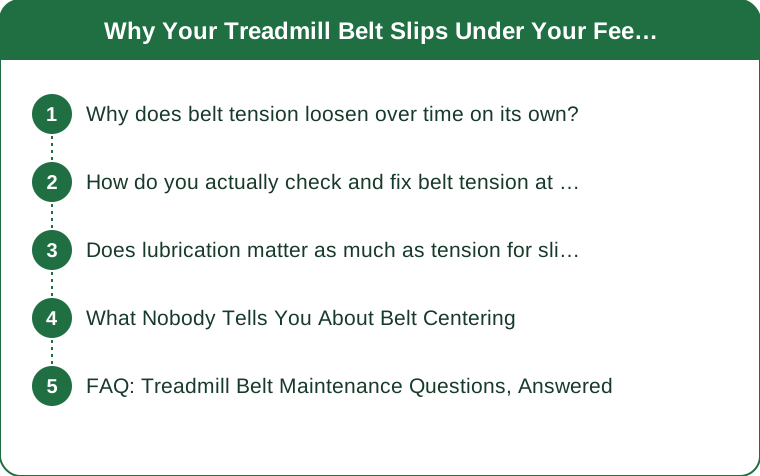
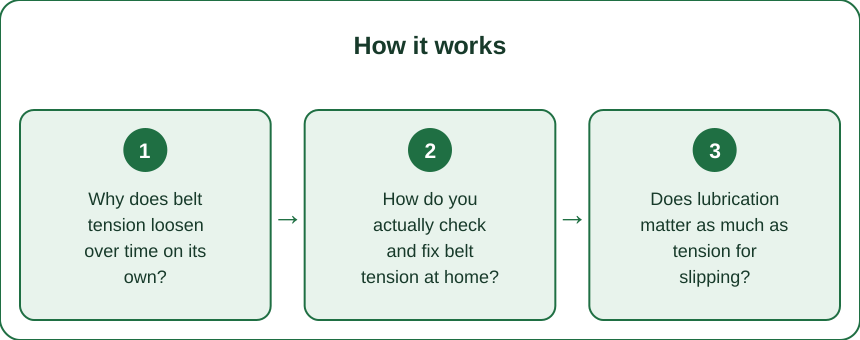
Why does belt tension loosen over time on its own?
Because regular use gradually stretches the belt material and loosens the tension bolts at the rear roller, a normal wear pattern rather than a defect — most treadmill manufacturers recommend checking and adjusting tension every few months of regular use, a step that’s easy to skip since it doesn’t cause obvious problems until slipping starts.
How do you actually check and fix belt tension at home?
Lift the edge of the belt at the midpoint — more than 2-3 inches of lift indicates the tension is too loose. Most treadmills have two tension bolts at the rear roller; turning each a quarter turn (equally on both sides to keep the belt centered) and re-testing the lift height is the standard home fix, typically requiring only an allen wrench included with the treadmill or a standard hardware size.

Does lubrication matter as much as tension for slipping?
Often yes, and it’s an even more commonly skipped step — silicone-based treadmill belt lubricant applied between the belt and deck (not on top of the belt surface) reduces friction-based slipping and motor strain, and most manufacturers recommend this every 3-6 months depending on usage frequency, using a lubricant specifically rated for treadmill decks rather than generic household lubricant.
What Nobody Tells You About Belt Centering
A belt that’s drifted off-center, even without slipping, can cause uneven wear that eventually leads to slipping issues down the line — checking that the belt runs centered on the deck (adjusting the same rear tension bolts asymmetrically if it’s drifted to one side) is worth doing at the same time as a general tension check, since the two issues often develop together.
FAQ: Treadmill Belt Maintenance Questions, Answered
How often should treadmill belt maintenance actually be done?
Most manufacturers recommend a tension and lubrication check every 3-6 months for regular home use (3-5 sessions weekly), more frequently for heavier daily use.
Is it worth calling a technician instead of doing this at home?
For straightforward tension and lubrication, most home users can do this safely with the included tools — a technician becomes more worthwhile if slipping persists after these steps, which may indicate a motor or roller issue instead.
Can using the wrong lubricant damage the belt or deck?
Yes — non-silicone lubricants, or using too much, can actually increase slipping or damage the belt material over time, so using the manufacturer-specified type and amount matters.
TL;DR:
- Belt slipping is usually a tension or lubrication issue, not a sign of treadmill failure
- Check belt lift at the midpoint — more than 2-3 inches means tension needs adjusting
- Silicone-based lubricant between belt and deck, applied every 3-6 months, prevents most slipping
- Check belt centering at the same time, since drift and slipping often develop together
A 15-minute home maintenance check solves this far more often than people expect before assuming the treadmill needs replacing.
Keep Reading
This article is for general informational and styling purposes only. Fit, sizing, and product availability may vary.