Why an Unlubricated Treadmill Belt Makes Your Workout Feel Harder Than It Should
Quick Answer: An unlubricated treadmill belt creates real friction against the deck, which makes the motor work harder and makes your run feel harder at the exact same speed. Most manufacturers recommend 100% silicone lubricant every 3–6 months or every 150–300 miles. Do the hand-slide test: reach under the belt — if it feels dry rather than slightly slick, it’s overdue.
Your usual 30-minute run has felt harder for a few weeks. Same speed, same incline, more effort. You’ve blamed sleep, work stress, and possibly your own character.
Go put your hand under the belt. If it comes out dry, you’ve found your answer, and it isn’t about you.

Why Does My Treadmill Feel Harder to Run On?
Because friction between the belt and the deck has gone up, and you’re the one paying for it.
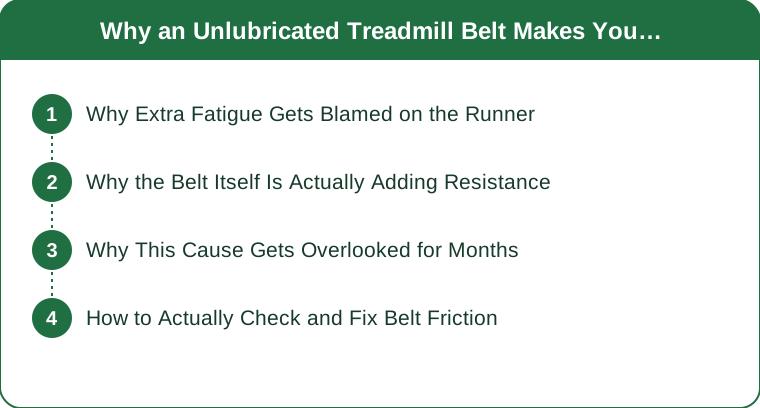
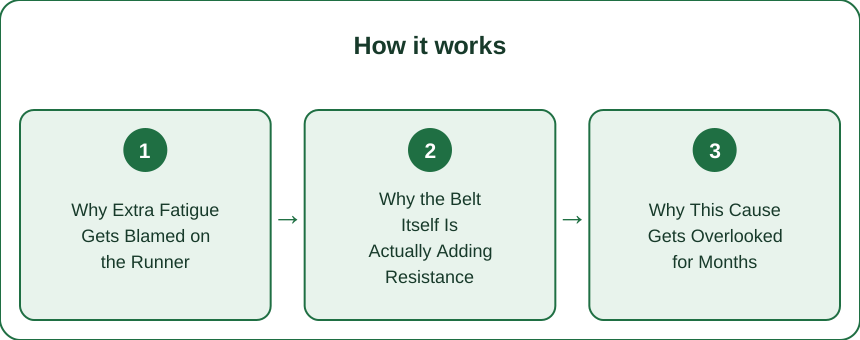
Here’s the mechanism. A treadmill belt slides across a fixed deck, and the surface between them is engineered to be low-friction — a factory silicone coating on the deck plus lubricant. Over months of use, that coating wears away.
As it does, the belt drags. The motor compensates by drawing more current to hold your set speed, which is why a badly maintained treadmill runs warm and sounds different. But the motor isn’t the only thing absorbing the difference: increased belt drag also means the belt resists your foot’s push-off, so you’re doing more work per stride at an identical displayed pace.
The number on the console says 6.0 mph. It’s telling the truth about the belt. It’s not telling the truth about how much work you’re doing to keep up with it.

Why Does This Go Unnoticed for Months?
Because friction builds gradually, and gradual changes hide inside normal variation.
No single run is dramatically different from the one before it. You get maybe a 1–2% change week to week, which is well inside the range of how much your own energy varies day to day. So each individual session gets explained away — bad sleep, ate late, stressful week — and the trend never gets attributed to the machine.
By the time it’s obvious, six months have passed and you’ve quietly built a story about your fitness declining.
There’s a second reason it stays hidden: treadmill maintenance is invisible by design. Nothing on the console warns you. There’s no light, no reminder, no error. The friction is between two surfaces you’d only see by lifting the belt, and most people never have a reason to.
Cost matters too. Running a treadmill dry doesn’t just make workouts harder — it wears the belt and deck faster and stresses the motor and controller. A $15 bottle of silicone lubricant prevents repairs that run into the hundreds.
How Often Should You Lubricate a Treadmill Belt?
Check your manual first, since specifications vary by model. General guidance:
- Light use (under 3 hours/week): every 6 months
- Moderate use (3–5 hours/week): every 3–4 months
- Heavy use (5+ hours/week): every 2–3 months
- By distance: roughly every 150–300 miles
The hand-slide test settles it in ten seconds. With the machine off and unplugged, reach under the belt near the middle and slide your hand along the deck. It should feel slightly slick, like a waxed surface. Dry, tacky, or grabby means it’s overdue.
How to apply it:
- Unplug the machine. Every time.
- Use 100% silicone lubricant, applicator bottle or spray. This is not optional — see the warning below.
- Lift one edge of the belt and apply in an S-pattern along the underside, focusing on the middle third where your feet land.
- Repeat on the other side.
- Walk on it at low speed (2 mph) for 3–5 minutes to distribute the lubricant evenly.
Do not use WD-40, household oils, cooking spray, or petroleum-based products. They degrade the belt material, attract dust, and can damage the deck. This is the most common and most expensive treadmill maintenance mistake there is.
Also worth checking while you’re in there: belt tension (the belt should lift about 2–3 inches at the center) and belt tracking (it should run centered, not drifting to one side). Both have adjustment bolts at the rear, and both affect how the machine feels.
The 5 Treadmill Maintenance Mistakes
- Using the wrong lubricant. Only 100% silicone. Everything else does damage.
- Over-lubricating. More isn’t better — excess collects dust and creates slipping. Follow the manual’s quantity.
- Never vacuuming underneath. Dust drawn into the motor housing is a leading cause of treadmill motor failure. Vacuum under and behind the machine every couple of months.
- Ignoring belt tension. A loose belt slips under foot strike; an over-tight one strains the motor and bearings. 2–3 inches of lift at the center is the usual target.
- Assuming a “maintenance-free” model needs nothing. Some decks are pre-lubricated for a long service life, but “extended” isn’t “never.” Check the manual rather than assuming.
FAQ
How do I know if my treadmill needs lubrication?
The hand-slide test is the quickest check: unplug the machine, reach under the belt, and slide your hand along the deck. A properly lubricated deck feels slightly slick; a dry, tacky, or grabby surface means it’s overdue. Other signs include the belt hesitating or catching under foot strike, and the motor sounding louder or running hotter than usual.
Can I use WD-40 on a treadmill belt?
No. WD-40 is a solvent and penetrating oil, not a lubricant for this application — it degrades the belt backing and deck surface and can cause damage that costs far more than the correct product. Use only 100% silicone lubricant made for treadmills.
What happens if I never lubricate my treadmill?
Friction rises steadily, so workouts feel progressively harder at the same settings, the belt and deck wear out faster, and the motor and speed controller run under increased load. Motor and controller failures are among the more expensive treadmill repairs, and dry-deck operation is one of the more common causes.
TL;DR:
- A dry belt-to-deck surface adds friction, so the motor works harder and so do you at the same displayed pace
- The change is gradual (1–2% a week), so it hides inside normal day-to-day energy variation
- Lubricate every 3–6 months or 150–300 miles, per your manual
- Use only 100% silicone — WD-40 and household oils cause real damage
- Hand-slide test under the belt: slightly slick is good, dry or tacky means it’s overdue
Keep Reading
This article is for general informational and styling purposes only. Fit, sizing, and product availability may vary.