Why 1% Incline Doesn't Actually Match Outdoor Running (The Real Number)
Quick Answer: The ‘1% incline’ rule was originally meant to offset the lack of wind resistance on a treadmill, not to fully replicate outdoor terrain. For most recreational paces, 1% is a reasonable approximation, but faster paces (under 7-min miles) may need slightly more, and the rule doesn’t account for actual outdoor hills at all.
You’ve heard it in every running forum: set the treadmill to 1% and it ‘feels like outside.’ It’s not wrong, exactly — it’s incomplete. Here’s the calibration most runners are missing.

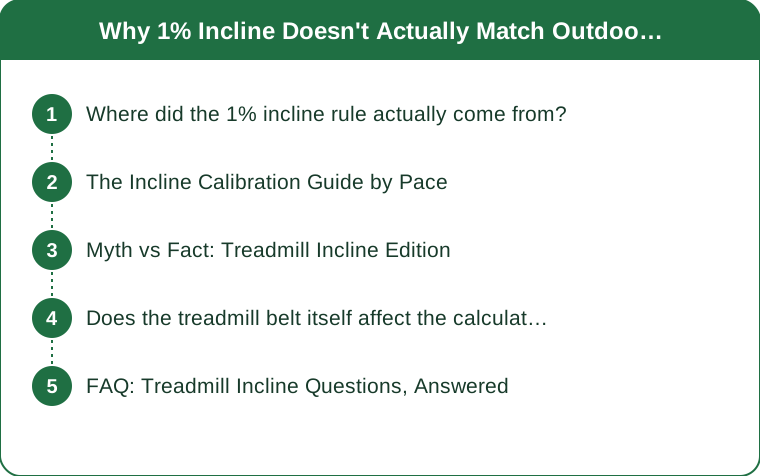
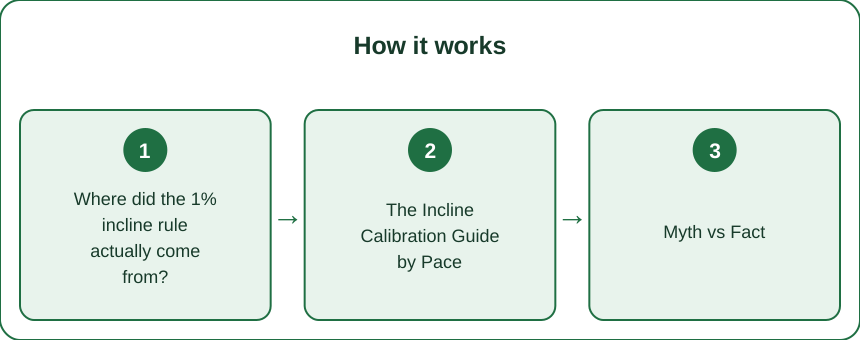
Where did the 1% incline rule actually come from?
It traces back to a small, often-cited study on the energy cost difference between treadmill and outdoor running, which found wind resistance accounts for a small but real energy cost at typical training paces — and 1% incline approximately offsets it.
The rule was never meant to simulate terrain — just to correct for the flat, wind-free nature of an indoor belt versus open air.
The Incline Calibration Guide by Pace
The energy-cost gap from wind resistance grows with speed, since wind resistance itself scales with velocity. That means:
- Easy/recreational pace (10+ min/mile): 1% is a solid approximation.
- Moderate pace (7-9 min/mile): 1-1.5% is closer.
- Fast pace (sub-7 min/mile): some coaches suggest up to 2%, since wind resistance cost rises faster than the standard 1% accounts for.
This isn’t an exact science — it’s a reasonable adjustment, not a precise formula.

Myth vs Fact: Treadmill Incline Edition
Myth: 1% incline replicates real outdoor hills. Fact: It offsets wind resistance on flat ground only. An outdoor route with actual elevation gain is a completely different stimulus that no flat-treadmill percentage replicates.
Myth: Higher incline always means a better workout. Fact: Above matching your outdoor pace’s wind-offset, added incline changes muscle recruitment (more calf and glute emphasis) — useful for strength, but it’s a different workout, not a ‘better’ version of the same one.
Myth: Treadmill running is easier than outdoor running regardless of incline. Fact: At matched, properly-calibrated effort, studies show comparable physiological cost — the perception of ‘easier’ often comes from consistent footing and pacing, not reduced effort.
Does the treadmill belt itself affect the calculation?
Yes, slightly — the treadmill belt does a small amount of the leg work for you compared to pushing off stationary ground, which is part of what the incline offset is compensating for in the first place. Belt speed consistency (vs. the natural pace variation of outdoor running) is a separate factor that affects perceived effort but isn’t part of the incline calculation itself.
FAQ: Treadmill Incline Questions, Answered
Should I always run at an incline on the treadmill?
For general fitness, 1-1.5% is a reasonable default. For race-specific training on a flat outdoor course, matching 1% keeps effort comparable without changing your running mechanics.
Does incline change injury risk?
Higher inclines increase calf and Achilles loading — worth building up gradually rather than jumping straight to 3-4% for long runs.
How do I train for an outdoor hilly race on a treadmill?
Vary the incline throughout the run to simulate rolling terrain rather than holding one flat percentage the whole time — intervals of 3-5% mixed with flat sections mimic real elevation change better than a static setting.
TL;DR:
- 1% incline was designed to offset missing wind resistance, not to replicate hills
- Faster paces (sub-7 min/mile) may warrant slightly more than 1%
- Higher incline changes muscle recruitment — it’s a different workout, not just a harder version
- For hilly race prep, vary incline throughout the run instead of holding one flat number
Set incline based on your actual pace, not a blanket rule, and treat real elevation training as a separate goal entirely.
Keep Reading
This article is for general informational and styling purposes only. Fit, sizing, and product availability may vary.