Should You Run on a Treadmill Every Day? The Honest, Question-by-Question Answer
Quick Answer: Running on a treadmill every day isn’t inherently harmful, but running the same intensity and distance daily raises overwrite-injury risk regardless of surface. The treadmill itself is actually gentler on joints than pavement — the real variable is whether your daily runs vary in intensity, not whether you run daily at all.
Daily treadmill running gets blamed for injuries that are usually caused by something else entirely: no variation in pace, no rest between hard efforts, and ignoring early warning signs of overuse.

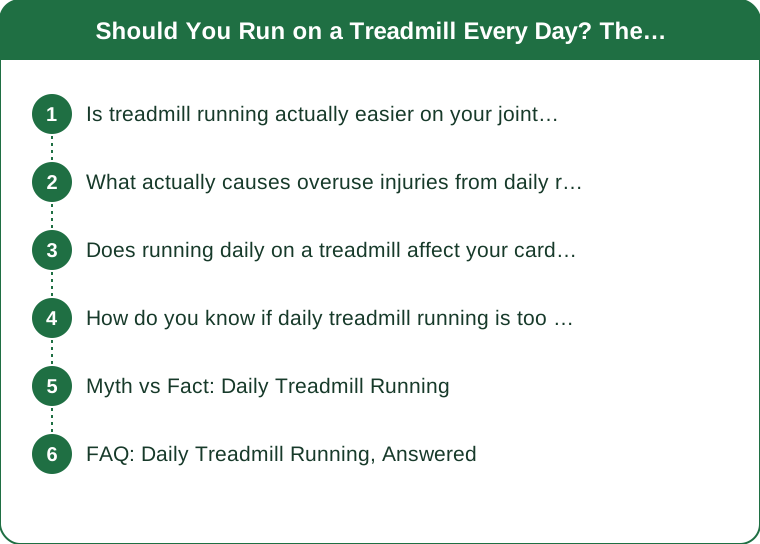
Is treadmill running actually easier on your joints than outdoor running?
Yes, measurably. Most treadmill belts have some built-in shock absorption that reduces impact force by roughly 15-20% compared to concrete or asphalt. This is one of the more consistent, well-supported findings in running research and is part of why treadmills are frequently recommended during a return from injury.
This doesn’t make daily treadmill running risk-free — it means the surface itself isn’t the limiting factor the way people often assume.
What actually causes overuse injuries from daily running, if not the treadmill itself?
The real driver is running the same pace and distance every single day without any easy days built in. Muscles, tendons, and joints adapt to stress during recovery, not during the run itself — daily maximum effort with zero variation removes that recovery window entirely, regardless of what surface you’re running on.
The fix isn’t necessarily fewer days; it’s structuring your week with at least 2-3 genuinely easy or short sessions mixed with your harder efforts, so your body gets a real chance to adapt between them.
Does running daily on a treadmill affect your cardiovascular fitness differently than running outdoors?
Not meaningfully — your heart and lungs respond to sustained effort and heart rate, not to the specific surface underneath your feet. Daily aerobic exercise on a treadmill builds cardiovascular fitness through essentially the same physiological pathway as outdoor running, assuming similar effort and duration.
One small difference: the lack of wind resistance and consistent, flat terrain on most treadmills means your effort at a given speed is often slightly easier than the same pace outdoors, which is worth factoring in if you’re training specifically for an outdoor race.

How do you know if daily treadmill running is too much for your body specifically?
Watch for the same warning signs that apply to any running frequency: persistent soreness that doesn’t resolve within 24-48 hours, a specific point of pain that shows up at the same mileage every session, or declining performance despite consistent effort. These are signals to add a rest day or an easy day, not necessarily to stop running daily altogether.
General fatigue that resolves with a good night’s sleep is a normal training response; sharp, localized, or worsening pain is not and warrants a break and possibly a professional evaluation.
Myth vs Fact: Daily Treadmill Running
Myth: The treadmill’s repetitive motion is worse for your joints than varied outdoor terrain. Fact: Repetitive motion exists in outdoor running too — most runners follow largely repetitive stride patterns regardless of surface. The treadmill’s shock absorption often makes it the gentler option.
Myth: You need a full rest day between every single treadmill run. Fact: What you need is variation in intensity, not necessarily complete rest. An easy 20-minute walk-jog can serve as active recovery between harder efforts.
FAQ: Daily Treadmill Running, Answered
Is it bad to run on the treadmill every single day with no rest days?
It’s not automatically bad if you vary intensity and duration across the week, but most runners benefit from at least one fully easy or low-impact day for genuine recovery.
Does treadmill running burn fewer calories than outdoor running?
At the same pace and incline setting, calorie burn is comparable. Setting the treadmill to a slight 1-2% incline compensates for the lack of wind resistance found outdoors.
How do I know if I should add a rest day to my daily treadmill routine?
If soreness lingers past 48 hours, if a specific joint or tendon consistently hurts, or if your pace is declining despite consistent effort, that’s your signal to add an easy day before pushing through.
TL;DR:
- Treadmill surfaces absorb 15-20% more impact than pavement, making them gentler on joints
- The real injury risk is running identical intensity every day, not daily running itself
- Build in 2-3 genuinely easy sessions per week even if you run daily
- Persistent, localized pain (not general soreness) is the signal to actually take a break
Daily running on a treadmill isn’t the problem — daily running with zero variation is.
Keep Reading
This article is for general informational and styling purposes only. Fit, sizing, and product availability may vary.